
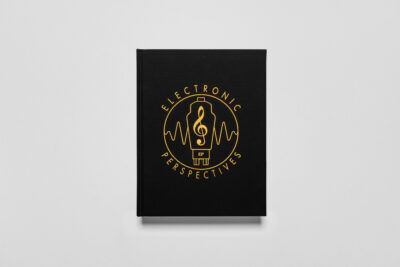
Tom Rhea has written extensively about historical electronic instruments, with an emphasis on analog synthesizers. As the author of a series of fifty-two one-page articles published in Contemporary Keyboard magazine under the title “Electronic Perspectives,” Rhea described innovative instruments in every issue between January 1977 and June 1981. His articles provided condensed histories of specific instruments and discussions of elements of electronic music described in historical contexts. Rhea has now re-published the original articles in this large-format 400-page book. The contents page lists fifty-one instruments as article titles: an engaging, stimulating, and often rivetting list. The book as a whole presents Rhea’s articles as a cohesive history of the creation of new instruments inspired by a collective history of engagement with circuitry.
Each article carries the same layout and design as the original, now enhanced by abundant archival photographs printed in high resolution, with many expertly restored by Joseph Bastardo, who designed the entire package. The book includes a comprehensive pair of CDs demonstrating developments in electronic music, curated and produced by Brian Kehew. This project was clearly a monumental undertaking. As Larry Fast points out in his foreword, Rhea was “making sense of the stew,” researching a vast array of innovations and providing historical, technical, and musical context for readers.
Rhea’s first Keyboard article provides an overview of the applications of new technologies throughout the long history of musical instrument design, followed by three articles on the Cahill Telharmonium, one of the first and largest electronic instruments. The series continues with two articles on the Hammond organ. Six articles on the RCA synthesizer appear toward the end of the book, followed by articles on the Moog and Buchla synthesizers. Rhea’s 1979 article “On Synthesis and Synthesizers” provides a succinct introduction to the basics of sound production. His concluding article, “Music & the Computer,” contextualizes digital sound storage and playback and includes an informative discussion of technologies used in music, describing projects led by Max Mathews at Bell Labs, where, as Rhea points out, “numbers became sound.”
Obscure but significant instruments mentioned include Hellertion’s 1928 continuous linear pitch controller, which influenced future keyboard designs. Discussion of the 1929 Coupleaux/Givelet synthesizer (named after its inventors) is accompanied by five pages of images, four showing elements of the patent application. The sounds of Hugo Gernback’s 1926 Pianorad (the “rad” part of its name indicating its role in radio broadcast) were heard on WRNY radio for several years. The 1934 Syntronic Organ using photoelectric controllers was designed by Ivan Eremeeff in collaboration with Leopold Stokowski. Rhea outlines some remarkable features of the instrument, such as the envelope controller that transformed light patterns on film into sound.
Harald Bode’s 1937 Warbo Formant Organ (shown in an old newspaper clipping) used controlled frequency bands through fascinating strategies. Later that year his Four-Voice Assignment Keyboard was released. Two further articles describe his later instruments, accompanied by four tracks on the CD and nine pages of visual documentation. Seven pages of images illustrate instruments invented by Hugh Le Caine. Images of early studios demonstrate the spatial organization of sound equipment before the miniaturization of modern electronics. Many well-known composers are seen in studio contexts: Pauline Oliveros and Morton Subotnick each play the Buchla; Wendy Carlos plays the Moog.
The book concludes with four pages of liner notes for the fifty-three tracks on the two accompanying CDs: well over four thousand words of explanation succinctly summarizing each track. The credits provide a glimpse of the detailed research that led to the identification of these rare recordings, many not available outside private archives. Playing methods invented by performers are demonstrated in a 1919 recording of Regina Farrington on the Choralcelo, and Daphne Oram on her Oramics photoelectric system in 1972. Clara Rockmore plays Saint-Saëns’ The Swan on the Theremin built specifically for her. Four tracks demonstrate the Ondes Martenot, including a 1937 composition performed by Maurice Martenot and an undated recording of a Jeanne Loriod demonstration.
Rhea’s Keyboard articles combine detailed explanation with discussion of broader perspectives, placing the instruments in their historical, technological, and musical contexts. Although Rhea points out some incomplete elements, this book succeeds as an encyclopaedia of the history of electronics in music. It also quietly demonstrates the vitality of communities of musicians over decades of accomplishment. The result is a treasure of technical and artistic storytelling.
Gayle Young is a composer, performer and writer and has been involved with Musicworks over many years.