
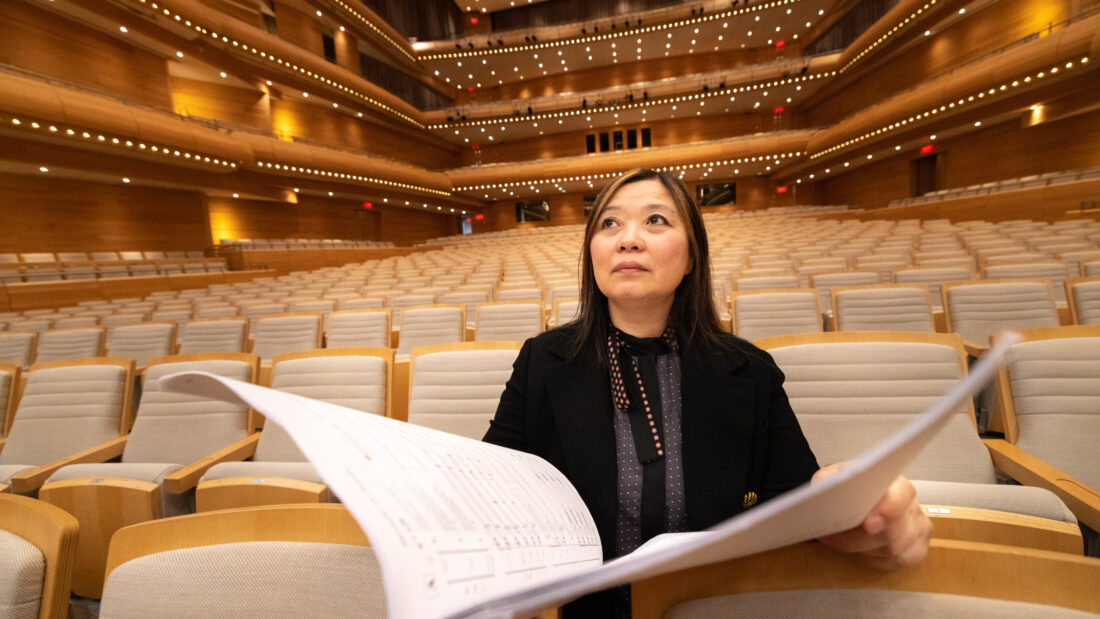
Birdsong filled the air at Lincoln Center’s Alice Tully Hall on the evening of March 28, 2024. It wasn’t works of Beethoven, Respighi, or Messiaen—all of whom found muses in European birds—and it wasn’t particularly tuneful birds being invoked, either. “The vast majority of Canadian birds are not songbirds,” Rita Ueda, the composer of Birds Calling… from the Canada in You, told me earlier in the day, adding that “Canadian bird songs are very, very different than other nations’ bird songs.”
Plans for Birds Calling were first hatched, so to speak, in the mid-1990s, when Ueda was living in Muskoka, a region in Ontario’s cottage country, and enrolled in Arraymusic’s annual Young Composers Workshop, led by Linda Catlin Smith in Toronto. “When you wake up in Muskoka, the sheer volume, the din of the birds, is overwhelming,” Ueda told me. “It was ten times louder and more diverse than any jungle I’ve lived in—and I’ve lived in the jungle in Indonesia.”
The piece didn’t find its footing until November 2021, when Ueda was named the 2022 recipient of the Azrieli Commission for Canadian Music, a biennial commissioning prize which includes a cash award as well as performances and a professional recording of the work. Ueda had originally conceived the piece as a fanfare for Canada built around the white-throated sparrow’s song, which was prominent in her Muskoka morning soundscapes. But when she was composing, the issues behind disturbing news stories—the dark history of residential schools, increasing gun violence, the COVID-19 trucker convoy protest—shook her belief in Canada. She began to consider Canada not as a single nation but as a crossroads of many cultures, something she experienced in Vancouver’s Chinatown, the neighbourhood where she grew up. “Canadians have a multicultural society,” she said. “We’re expected to master our own culture but also be able to collaborate with other cultures.”
Birds Calling… from the Canada in You had its world premiere in October 2022 in Montreal (performed by l’Orchestra Métropolitain de Montréal, with Alexandre Bloch conducting), followed by performances in London in October 2023 (the Philharmonia Orchestra, with Steven Mercurio conducting), in Toronto in January 2024 (the Esprit Orchestra, with Alex Pauk conducting), and in New York in March 2024 in a concert celebrating the Azrieli Music Prizes’ tenth anniversary (the Orchestra of St. Luke’s, with Steven Mercurio conducting); all four concerts featured soloists Naomi Sato on shō and Zhongxi Wu on suona and sheng (all ancient reed instruments).
Birds Calling… from the Canada in You takes the form of a double concerto for solo shō, suona, sheng, and orchestra. For the piece, Ueda listened to recordings of more than 450 Canadian bird songs, but she also drew from her own migratory life. In keeping with the composer’s intercultural practice, the work borrows from both Asian and Western traditions. The score incorporates demanding yet quite beautiful writing for the Asian reeds atop the orchestra, depicting communities of birds and people coming together.
“It takes a couple of years to write an intercultural piece, because the learning curve is so steep,” Ueda said. “All too often, it’s the international players—I don’t like the term non-Western—that do the heavy lifting. They’re expected to play in tune with the Western orchestra’s standard of tuning.” They also have to learn Western notation, style, and how to work with a conductor. “It’s a lot of work for them. I wanted to create something where the orchestra meets them halfway.”
Rather than being forced into Western structures, the shō part is improvised within a randomized chord sequence, while the sheng and suona parts are improvised based on a text score that incorporates bird songs. The conductor has the hardest part, Ueda said: “There’s no time signature, so they’re not really keeping time, just directing the structure.”
Birds Calling fills the second half of the Lincoln Center concert. The twenty-seven-minute piece begins with a morning breeze, just momentarily, from the breath of woodwind players positioned in the balconies. Orchestral whistles soon appear, along with a pair of tailor-made waterphones. A harp arpeggio awakens the forest, and the shō and sheng appear on either side of the stage. It feels magical—something that would almost be trite if it didn’t work so well.
Wu and Sato move to centre stage and Wu delivers melodic lines like he’s playing a handheld pipe organ. Sato initially gives rudimentary responses. Wu and the woodwinds initiate a chorus of bird calls, drawing the laughter of familiarity from the audience. Some impressive circular breathing carries a double-reed line longer than many birds might manage. A deep call from the bass clarinet suggests a loon. The whole orchestra then chimes in. It’s loud and cacophonous; the forest few of us hear. Wu engages in a duo—more like a duel—with a percussionist armed with marching band cymbals. He eventually wins the territorial battle, driving the other male off and emitting a short, celebratory song, one hand on his hip in boastful pride.
But it’s not all joyful reverie. The orchestra returns, slower and quieter now, and Sato stands up. Sadness and orchestral tensions fill the hall. Sato initiates a staccato phrase over blurry strings and a brass crescendo blasts from the rear of the hall.
Ueda has literally set us up for a fall. Something that sounds like a shofar (an ancient instrument made of a ram’s horn) calls from the back, repeats a few times, then the strings respond. A counterpoint to a three-note herding call is not something I’ve heard before. Then, with a blast from the sheng and the loud beating of a drum, the lights go out. It’s a dramatic ending, although not quite the gunshot sound she wanted.
Ueda moved from Hakodate, Japan, to Vancouver, British Columbia, at age seven with her parents and younger brother. She was never told why her family relocated (“Suddenly one day my father announced, “Pack your bags.’”). The move represented a huge drop in the family’s standard of living. Her mother had been a professional opera singer and her father was a poet. “I remember going back and forth to Europe watching my mom practise,” Ueda said. “The first opera I watched was Faust. It scared the daylights out of me.” Once in Canada, her mother found work in a restaurant, her father in a factory. “They were teenagers during World War II. I think their dream was to have a normal life with a normal home and have normal kids with normal jobs.”
By the time she arrived in Vancouver, Ueda was already composing. “I don’t really play anything well enough to play in public,” she said. “I started out on flute. I play viola even worse. My string writing is based on my inability to play strings. At one time, I made a living teaching little children to play ‘Hot Cross Buns.’”
Although Ueda no longer remembers the name of her first music teacher, she recalled that he was in his nineties and had known Tchaikovsky and Brahms, and that he took her to concerts to hear John Cage, Morton Feldman, and Steve Reich. “Almost all my composing with him was improvisation and graphic notation,” she said, “but I guess if you have to teach a three-year-old, a three-year-old can’t read notation.”
She would go on to earn her MFA in 1997 at California Institute of the Arts, studying under Rudolf Komorous, Stephen “Lucky” Mosko, and David Rosenbloom, and working closely with Lou Harrison, Wadada Leo Smith, Morton Subotnick, and James Tenney. In 2011, she was accepted to the Ostrava Days Institute and Festival in the Czech Republic, where she found the spirit to incorporate improvisation and conceptual approaches to her work. She returned to the institute in 2013, 2015, and 2017.
“It all started with Petr [Kotik, founder and artistic director], and with Ostrava,” she said. “I did not have the nerve to try something like this [until] ten years ago.”
This July, Ueda received her PhD in Music from the University of Durham in the U.K. Birds Calling was completed at Durham, as were a trio, a quintet, and a chamber opera, each incorporating multiple traditions. In November 2023, her opera I Have My Mother’s Eyes: A Holocaust Memoir Across Generations premiered on Gabriola Island and was also performed at the Chutzpah! Festival in Vancouver; it’s based on Barbara Ruth Bluman’s memoir about her mother, who was among thousands of Jews helped by the Japanese consul in Lithuania during the Holocaust. Last year also saw performances of Ueda’s as the first spring blossoms awaken through the snow for an intercultural orchestra in South Korea and Taiwan, the premiere of Byakuya: Midnight Sun Songs in Tokyo, and new works performed by Turning Point Ensemble and at the Blueridge Chamber Music Festival in Vancouver.
In May 2025, Montreal’s Société de musique contemporaine du Québec (SMCQ) and the Voces Boreales choir will premiere a new Ueda work alongside new pieces by Samy Moussa and Tanya Tagaq, in a concert dedicated to composer Jocelyn Morlock, who died in March 2023 at the age of fifty-three. “It will take a long time for the Canadian new music community to recover from [Morlock’s] sudden death,” Ueda said in an email exchange after our interview. “I am saddened to be composing a new work in memory of such a wonderful soul who has been taken away too soon.” Next year will also see the world premiere of a new piano concerto by Ueda—performed by pianist Megumi Masaki and the all-female Allegra Chamber Orchestra—in March in Vancouver.
Instrumentation isn’t often first on the list when Ueda sits down to write music. “I have to decide what has to be in the score, and then I write, which is not the way I was taught,” she said. “It shows you how much things have changed in [the past] twenty or thirty years. The traditional model is that you’re supposed to have a sound in your head and write it down, and the success of the piece is how well the performers can play it.”
Instead of working strictly with dots on paper, Ueda’s music is developed with the musicians who will play it and the traditions of their instruments. “It’s not even considered a novelty to have a Chinese instrument or a Peruvian instrument in your ensemble,” she said. “It’s part of life in Vancouver.”
The resulting work is Ueda’s vision, but the product of collaboration, of people coming together to realize a common goal. “I don’t know what it’s going to sound like,” she said. “I create the situation and the collaborative environment so we can find out: What does this community sound like?”
Kurt Gottschalk is an author, journalist, and broadcaster based in New York City. His work appears in publications in North America and Europe, including Bachtrack, The New York City Jazz Record, The Red Hook Star-Revue, Stereophile, and The Wire and he can be heard on WKCR-FM and WFMU-FM.