
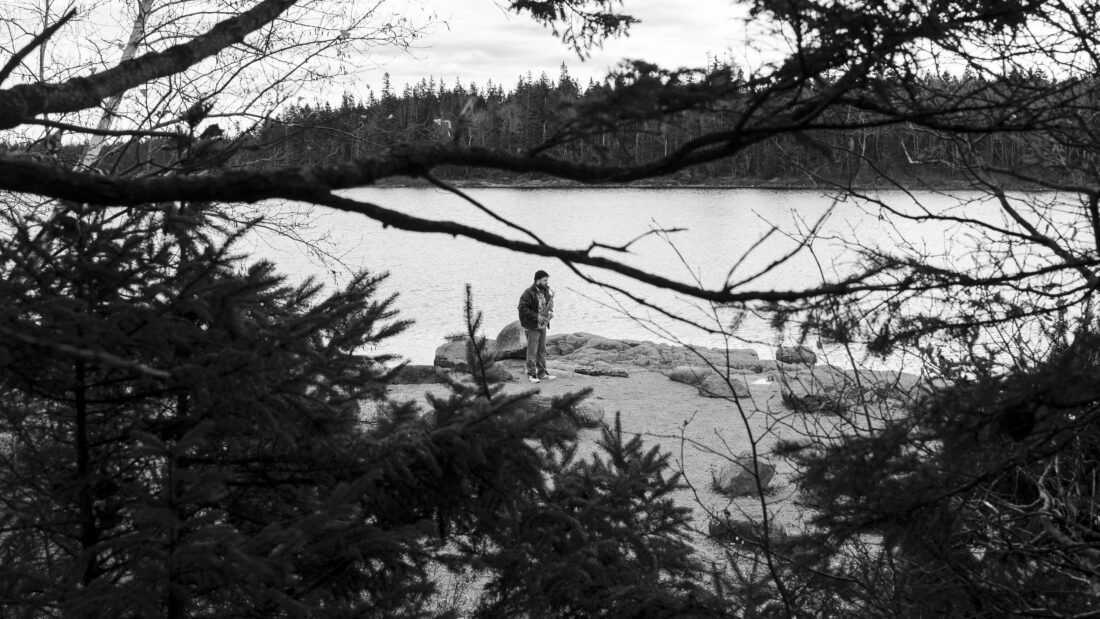
At all times, it seems, Andrew MacKelvie is listening. Not just in the sense of having one’s ears turned on in order to avoid peril, but focused listening—to the wind over Long Lake, where his ambient improvisational ensemble New Hermitage puts on its annual dawn concert; to the resonance of the big church hall in which he helps direct the Creative Music Workshop sessions; to the sounds of the audience at Ramblers, the Halifax café and bar that hosts the monthly New Hermitage & Friends series.
Even while driving in hellish Halifax rush-hour traffic, MacKelvie listens to the questions being lobbed his way and responds in a calm but engaged manner that exudes a buzzy peacefulness. He is visibly excited to chat about music, showing no trace of the jaded cynicism often held by seasoned musicians. New Hermitage, MacKelvie’s main group, is one of many in which he plays the alto saxophone. The quartet—cellist India Gailey, guitarist Ross Burns, harpist Ellen Gibling, and MacKelvie on woodwinds—imagines a world in the not-so-distant future where most major cities have become inhospitable due to high levels of toxicity in the soil, air, and water. While most people have taken to nomadism, wandering through the wastelands between cities, one group has returned to the cities “armed with patience and tenderness” to live in a new hermitage where they work in concert with the natural world in an attempt to restore ecological balance.
“They give shape to the world as the world gives shape to their work,” MacKelvie explains as he drives. “And that’s an allegory for how we play; we are listening to the space and listening to each other, and as the sound—the music—is telling us, giving shape to our performance, we give shape to the music.”
This idea of serving the music is central to MacKelvie’s musical practice. He was raised in Nova Scotia in the town of Pictou (population 3,186) on the Northumberland Strait and grew up with the swinging sounds of Colin James and the Little Big Band blasting through his dad’s car stereo. Entranced by the horn section, he decided to learn saxophone and started playing in junior high, eventually heading to Antigonish to study the instrument at St. Francis Xavier University, but the competitive nature of the music program wasn’t for him.
“I would look at the saxophone in its case and want to throw up,” he says. “I quit music.”
In 2008, between his first and second year at university, MacKelvie participated in the Creative Music Workshop, the long-running intensive summer music program founded by the late Jerry Granelli, a legendary jazz drummer who served as its creative director for many years. “[Bassist and longtime CMW faculty member] J. Anthony Granelli, Jerry’s son, at one point started talking about [the concept of] listening to the aggregate,” MacKelvie says, explaining, “If you listen to everything that’s happening, the music can often tell you what it needs. That’s the idea of service. And, you know, it’s going to be different for every person, depending on their thing. It blew my mind. It was the thing I was searching for. That moment changed the whole trajectory of my life.”
In 2010, MacKelvie started working as an assistant to Laura “Lulu” Healy, the artistic director of the Halifax Jazz Festival, and as an assistant coordinator of the Creative Music Workshop sessions. Despite his lingering negative feelings about the saxophone, MacKelvie felt he had found a kindred spirit in Jerry Granelli, and successfully applied for a grant to fund a mentorship with the elder musician. As MacKelvie describes it, the partnership is what built him back up. “[He had] this really holistic way of teaching: The body is the first instrument, the mind is the first instrument. And if that’s not functioning, how can anything else function?”
Part of that had to do with Granelli’s personal experience with addiction. He mentioned at one point that before he found meditation, he didn’t even know how to cross the street without being hammered. “He said, ‘If you’re suffering mentally, you need to figure that out,’” MacKelvie says. The lessons were intense and bred a deep trust between the two musicians, as well as revealing to MacKelvie what it takes to build that kind of trust.
The mentorship was akin to an old-school apprenticeship. MacKelvie gained access to Granelli’s studio and wisdom and assisted Granelli in return, doing everything from moving drums and grabbing sandwiches to transcribing charts. It wasn’t always or even frequently glamorous. But he was in the room, privy to the intimate details of how the drummer worked and thought. Granelli made sure MacKelvie was paying attention when things were happening. They eventually began playing together. “The first time I played with him, it was like I was hit by a tidal wave,” MacKelvie says. “If you weren’t there with him, he was going to leave you behind. I had never played with anyone where [that happened]. It was incredible.” In 2015, MacKelvie was an integral part of Granelli’s album What I Hear Now. In the summer of 2021, Granelli passed away at home in Halifax at the age of 80.
More than a decade of mentorship and friendship had primed MacKelvie to take up the torch that Granelli held in his community—one that burns for a better understanding of creativity, relationships, and how they are interconnected. New Hermitage functions under the guidance Granelli provided. When MacKelvie was first considering the project in the mid-2010s, he knew he wanted to share his listening process with people, and he set out to find them.
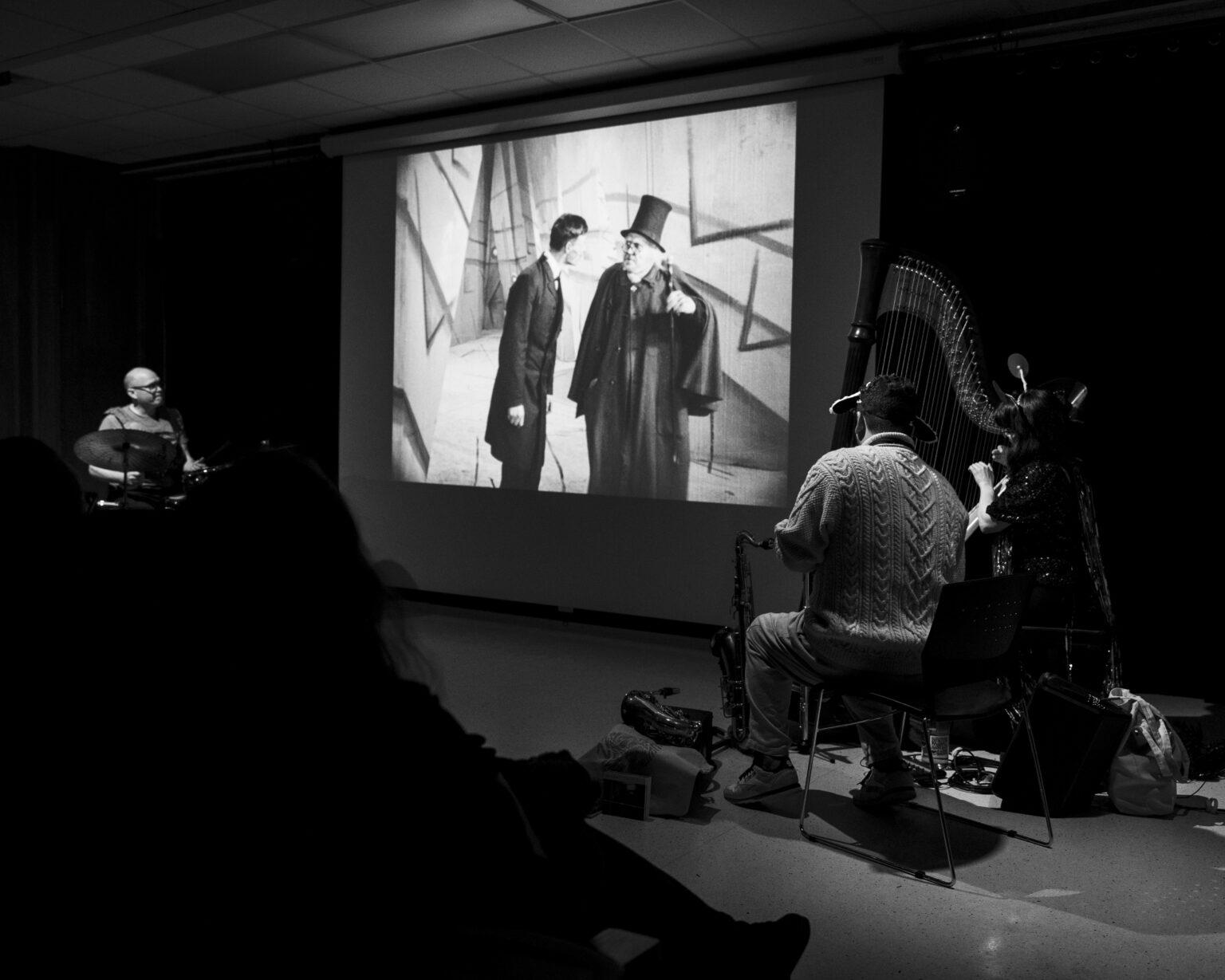
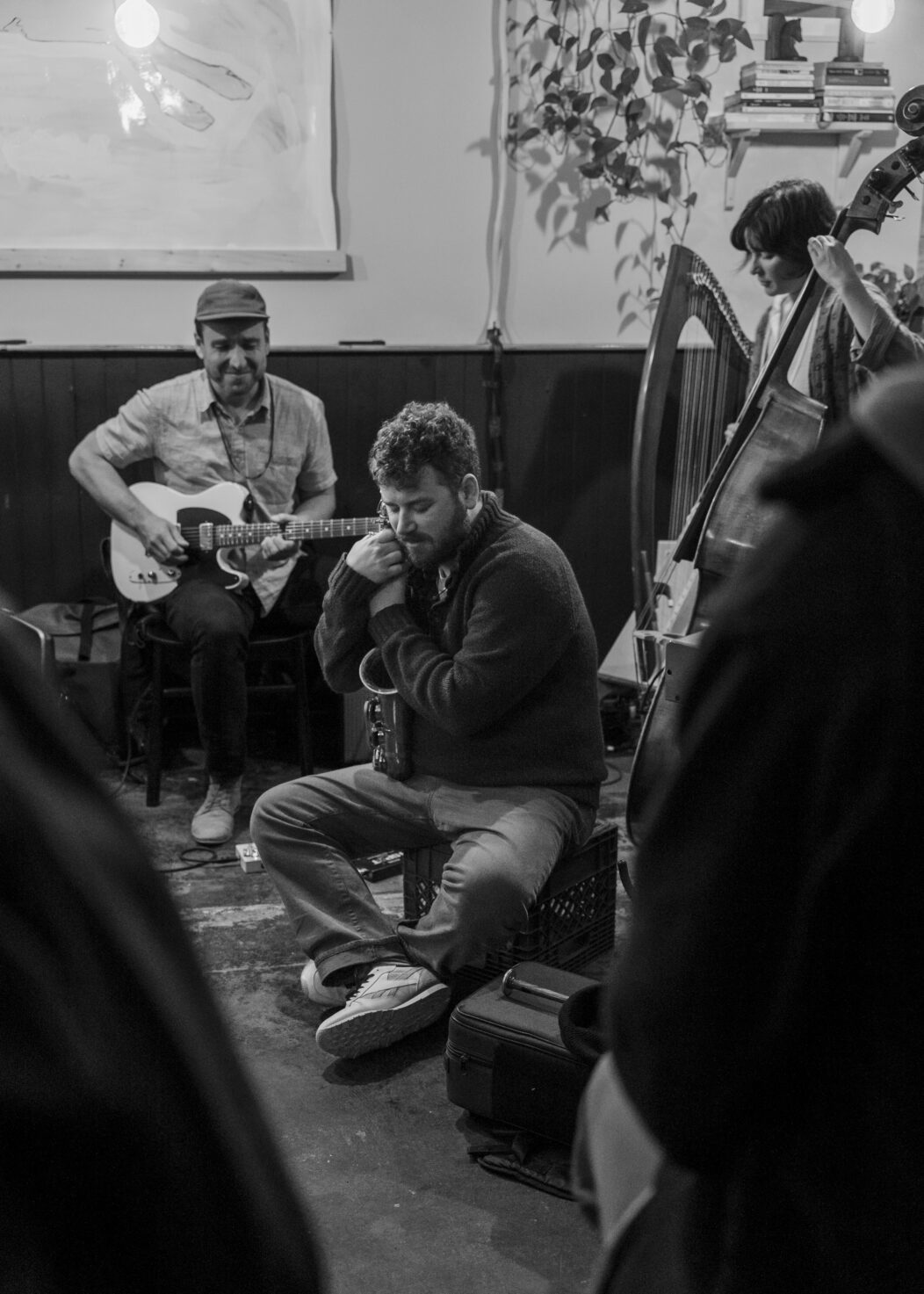
In late October 2023, in the fourth instalment of an annual Halloween series that has seen the ensemble create scores for the silent horror films Nosferatu, Faust, and Häxan, New Hermitage collaborated with Carbon Arc, Halifax’s only independent cinema, to present an improvised score for two screenings of The Cabinet of Dr. Caligari. Dressed in costume—MacKelvie opted for a wool sweater and a simple mask to turn himself into a lamb—the quartet built the eerie 1920 German classic into an appropriately strange and unsettling experience by watching, listening, and reacting, breathing life into the film’s fantastical and distorted sets and the ghostly, heavily made-up faces of actors Werner Krauss and Conrad Veidt. The music of each screening had its own feel and flow, each spooky in its own special way. The following weekend saw the cozy, warmly lit Ramblers packed for New Hermitage & Friends, which featured a collaboration with pianist and AI researcher Sageev Oore, who had stepped in at the last minute to replace Special Costello (Halifax musician Jeremy Costello). The flow of the shows depends on the guest artists and what they’re ready for; previous “friends” have included violin whiz Rachel Bruch, who performs as Blue Lobelia, and R&B powerhouse Lance Sampson, aka Aquakultre. Oore’s night was expansive, high-energy, frequently raucous and groovy, and never less than thrilling. Several participants from the Creative Music Workshop were in the audience, taking things in, listening, learning.
While these two small-scale, accessible, and intimate events illustrate how MacKelvie and New Hermitage are building community through music, the Creative Music Workshop takes that role much further. “The nice thing about this is that once you’re a part of it, you also own it. It’s a community. We don’t own this knowledge,” MacKelvie says. “Even when I was doing [the Creative Music Workshop] years ago, we would meet on Sundays, and there was a group of us who [thought] we would like to do this more—just on our own. So we’d get together on Monday mornings and rehearse, just practise. We’d guide ourselves.”
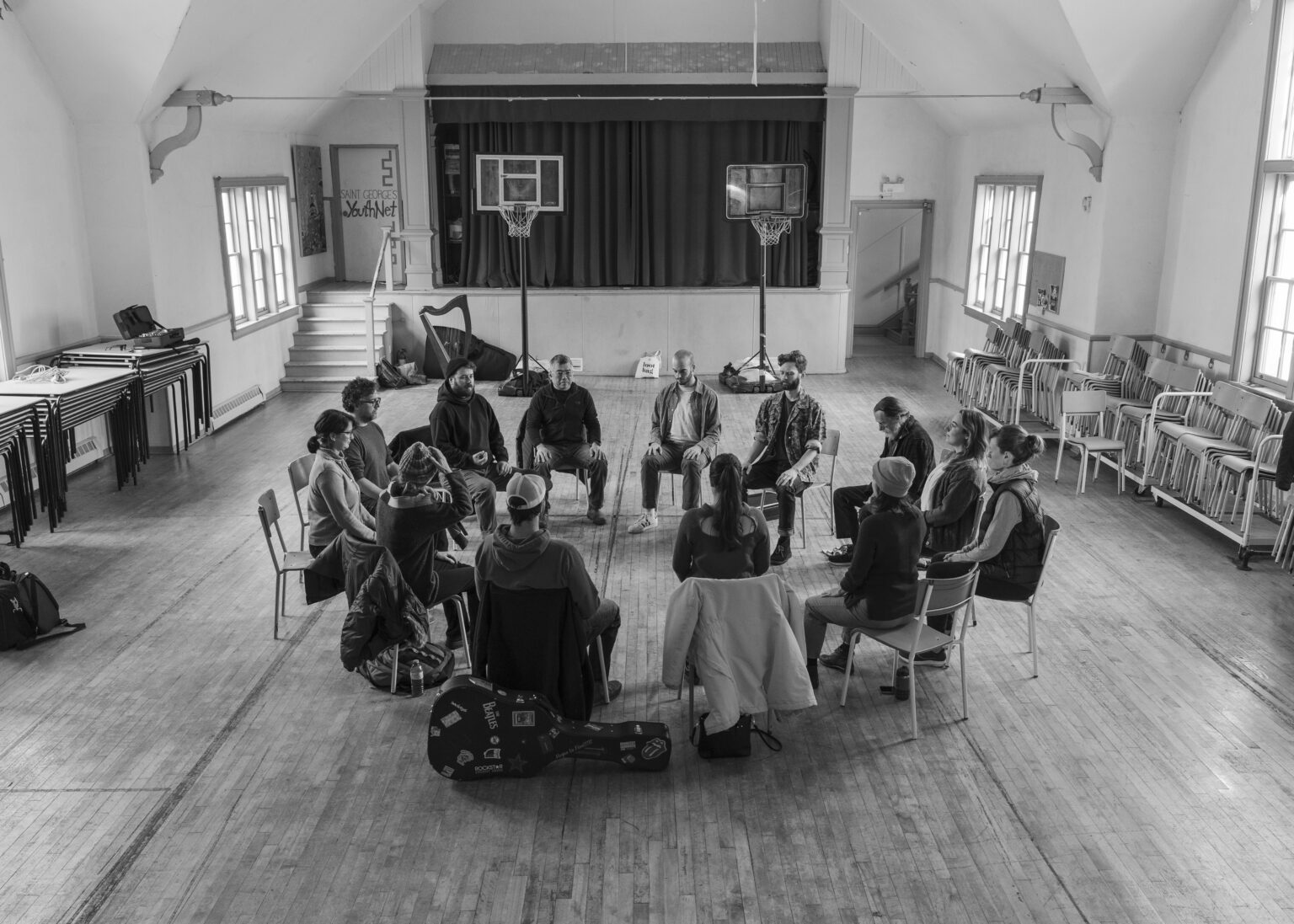
On a Sunday afternoon in early November, I took in one of the sessions. In a large hall behind Saint George’s Round Church, which is located in the north end of the city, participants milled about until it was time to take a seat in a circle of chairs. The whole scene had a vibe and an atmosphere that made it seem more like a group therapy session or twelve-step program meeting than a musical get-together. It soon became clear to me that this was by design. The sessions usually begin with a group meditation, which typically lasts from five to ten minutes, or a listening practice. “You start with the awareness of listening, and you pull it into the 360-degree sphere and expand it,” MacKelvie says. “Then you listen in a way that’s non-hierarchical, non-judgmental. If you notice yourself thinking about the things that you’re hearing, you just touch that thought and come back to listening.” Then there might be a discussion, and then they’ll get into exercises.
During the session I watched, the focus seemed to land on considering, listening, and reacting to the aggregate. “The total of all the sound in the improvisation is the music,” MacKelvie says. “It is the ‘nth’ member of the ensemble, the third member of a duo, et cetera.” In one exercise, half the participants began a rhythm by thumping on the floor or on their bodies; the other half, once they’d listened for a while, inserted their own rhythm into the sequence, and the two groups went back and forth for ten or fifteen minutes. Later, Gibling began playing a sequence on her harp; the neighbouring flutist listened for a while and began their own sequence; Gibling dropped out, the flutist continued, and a guitarist began the process anew. While the exercises, players, and focus can change every week, the structure of that day—conversations and exploration—was slow, intentional, and open, creating an atmosphere in which players could not only participate without fear of judgment but also deeply consider their choices and investigate why they might make them. It seemed to have far less to do with music—although music is primary here, of course—and much more to do with the actual textures of creation. The questions are simple but certainly fundamental, and perhaps not asked frequently enough: What can I offer this space, this moment? What is it offering me? And what do we make together?
Questions like this clearly drive MacKelvie. At his house, he speaks about the introduction of movement-based artists to the Creative Music Workshop, the connections between dance and music, and the differences and similarities between silence and stillness, and wonders aloud whether it is possible to bring them into some sort of communion.
“How can my silence have weight? I think with movement, there’s a potential energy in stillness,” MacKelvie says. “Because you’re like, well, that person . . . their arm is like this [gestures]. And there’s a physical element to this: It has to move. How can my silence have that same weight? How does it build? Is that something that can actually be felt? Or is it just an intention that I’m putting into it?”
There aren’t necessarily any concrete answers, but places like the Creative Music Workshop provide spaces for artists to sit inside these questions. At the end of the final set at Ramblers, as his friends play in a circle around him, MacKelvie—sitting close to the ground— clutches his saxophone close to his chest with his eyes closed and a soft smile on his face, as he often does; the essential method for exploring these ideas, it seems, is listening.
MATT HORSEMAN was born in Winnipeg, Treaty One Territory, and is based in Mi’kma’ki (Nova Scotia). His photography and writing have been published in National Geographic, the Globe and Mail, Canadian Geographic, VICE, No Depression, the A.V. Club, FADER, and other publications. His article “Jeremy Dutcher’s Gift for His People” (EDIT magazine) won the silver medal in the Short Feature Writing category of the 2019 National Magazine Awards. In 2020, he published his first book, Two Rivers (Axis Mundi Press). In 2022, he was nominated for the National Gallery of Canada’s New Generation Photography Award.