
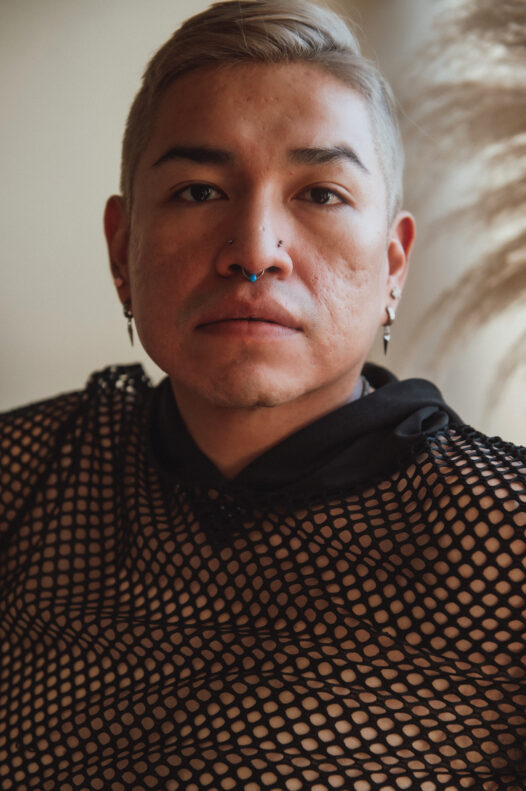
In his early teenage years, Sonny-Ray Day Rider started playing piano in the home of his paternal grandmother. The thirty-six-year-old Blackfoot composer from the Kainai Blood tribe was raised with the music of powwows and other ceremonial rituals, but it was this hands-on experience that set him on his creative path. While Day Rider is pursuing a master of music in composition at the University of Lethbridge—with the support of the inaugural Fine Arts Indigenous Graduate Admission Award—his undergrad studies began in science.
“I thought I was going to be a mad scientist,” says Day Rider with a laugh during a video call. “I took an art class and made an abstract charcoal portrait. Something clicked, and I knew I had to be creating. The sciences weren’t going so well, to be honest, so a few days later I switched my degree to composition. I don’t regret it to this day.”
Day Rider moved from the reserves of the Tsuu T’ina Nation to the Navajo Nation during his childhood and was primarily raised by his grandparents. When his grandmother passed away during the pandemic, he began working on a song cycle to process the lingering feelings of loss. The Grief Eater Firaga explores an emotional landscape that is transformed by immense pain and reflects the shedding of old life and the transition into a new state of being. The work begins with the stirring strings of Movement 1. Blood Offering and concludes with the mournful longing of Movement 2. Blood Elegy, where the composer envisions future frontiers. Recorded by Kensington Sinfonia for its 2023 album, Forces of Nature, Day Rider’s composition is programmed alongside pieces by Alberta composers Arthur Bachmann, Ashley Steward, George Fenwick, and Donovan Seidle, all of which were commissioned by the Calgary-based string orchestra led by concertmaster and violinist Genevieve Micheletti.
“The journey of grief is a cycle of catharsis,” says Day Rider. “Besides losing my grandmother, I’ve grieved the end of some relationships that weren’t the best. This process prepared me for challenges and was a chapter of my life that closed. Indigenous people are always talking about transformation and renewal, so I hope my music and thesis capture that.”
Comparing his grief to the landscapes he has called home, Day Rider views the stages of his emotional journey as a natural occurrence. Returning to the teachings of his elders, he believes that music allows the spirit world to communicate with the living. Yet when discussing the sacred spaces of the Blackfoot people, Day Rider thinks changes are needed in order to foster a sense of inclusivity for all.
“This might be a bit controversial, but some of those spaces are run by a male-dominated mindset,” he says. “Not many people realize how informed they are by patriarchy and colonialism. That’s because many of the people who run the ceremonies are residential school survivors, and those influences are there too. It doesn’t foster the environment that I want to create.
“I never really felt totally included in those spaces, because when the colonizers arrived, they erased gay history and women’s bodies, wiping out our understanding of those things,” Day Rider continues. “I think about queering the sacred as bringing in other dimensions of myself as a queer Indigenous person that I can visit, almost like gates to a different world.”
The term firaga may be familiar to players of the video game Final Fantasy as a flaming attack magic spell. Day Rider cites Nobuo Uematsu, composer of the music for the video game series, as a primary inspiration, alongside the Silent Hill film and video game composer Akira Yamaoka. Day Rider has carried these influences into his own scores—such as the 2019 short film Big Momma, which documents the personal journey of two-spirit comedian Preston Stimson—while creating a thematically linked body of work.
“I’ve been really fortunate with the chamber pieces I’ve done,” he says. “I have the creative power to do what I want. That’s how I’ve been able to turn these commissions into expressions of my grief and include them in my thesis cycle.”Looking ahead, Day Rider plans to compile the songs of The Grief Eater Firaga into his debut album, while continuing to explore the vast possibilities of electronic music. But his ambitions extend far beyond the typical Western notions of artistic success. “I’m trying to find self-love, untie generational traumas, and explore being queer in sacred spaces,” he says. “It’s funny, because when people talk to me about my music, I find it hard to describe. I have this mind, body, and spirit Indigenous experience, so you can’t talk about one aspect without talking about the others.”
Jesse Locke (he/him) is a writer and musician based in the traditional, unceded territories of the Musqueam, Squamish, and Tsleil-Waututh Nations, also known as Vancouver. He currently contributes to Pitchfork, Bandcamp Daily, Xtra, Musicworks, Tone Glow, and Aquarium Drunkard. Jesse hosts the music interview podcast “Tracing Spaces” and is the author of the biography Heavy Metalloid Music: The Story of Simply Saucer. He plays drums with the bands Tough Age, Motorists, and Chandra. Follow him on Twitter! @wipeoutbeat