
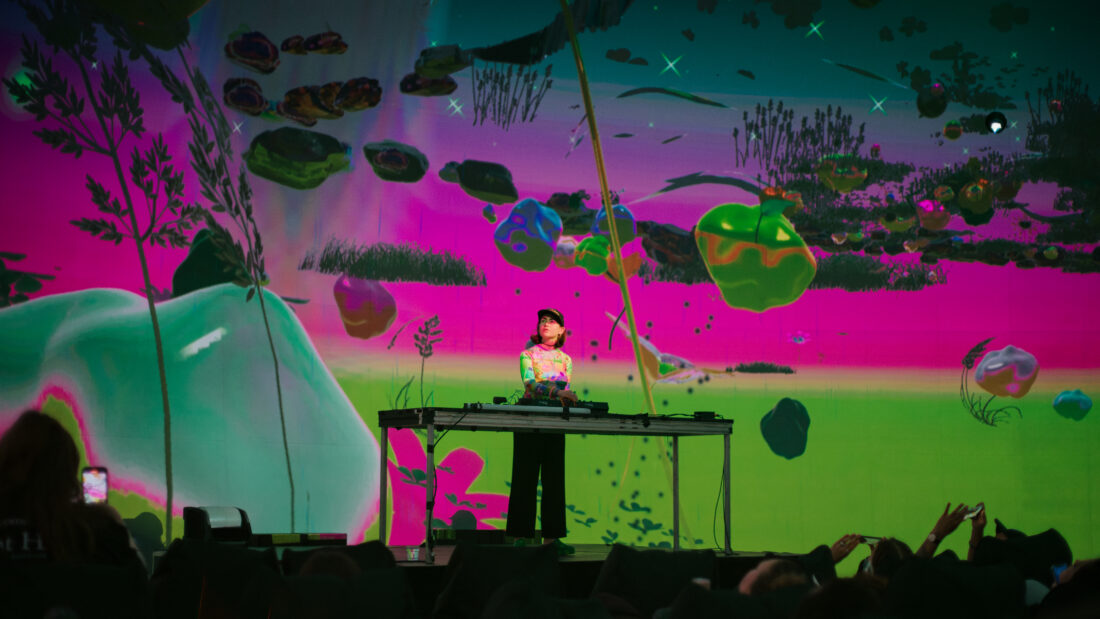
Captain’s log: Stardate 58541.8. Officer Fratila has been studying the electronic sounds of Earth’s inhabitants and producing her own sounds as a way to create a feeling of belonging. Her reports from the underground were frequent, then stopped completely. Before losing contact, Fratila sent this message: “I want to leave this Earth behind.”
While Stefana Fratila has never visited outer space, she’s a Trekkie whose work in sound and love of sci-fi led her to wonder: “If each planet in our solar system were a different room, what would each room sound like?” This idea opened up larger questions. How do you quantify something that humans cannot experience? How do you translate other worlds into sound? In search of answers, Fratila—a Toronto-based composer, co-founder of Crip Rave (a Toronto collective focused on making raves more accessible), sound designer, and sound editor (Sofia Coppola’s Priscilla)—contacted astronomers and scientists from the U.S. National Aeronautics and Space Administration (NASA), who provided opportunities for her to visit and conduct research at the NASA Jet Propulsion Laboratory and NASA Goddard Space Flight Center. This experience sparked an extended artistic project that Fratila launched in 2018 with the creation and release of eight open-source VST (virtual studio technology) plug-ins that emulate the atmospheric conditions of the planets. This was followed by an ambient album, a remix album, and, most recently, a collaborative immersive film with Diana Lynn VanderMeulen. Through this work, she uses her research-based sonics to point out that all inhabitants of Earth are rendered “disabled” in outer space.
This next song is gonna hurt.
Ravers often surrender their individuality and join the primal community created on the dance floor. Fratila, who co-founded Crip Rave with Renee Dumaresque in 2019, describes this entity as a meeting ground where people can connect regardless of identity. In the studio, in the laboratory, and on the dance floor, Fratila appears able-bodied, but she lives with chronic illnesses that come with pain and fatigue; from an early age she sought refuge in underground music. At a rave, a person with a mobility device will be given plenty of space to play, but what about a person like Fratila, who doesn’t always use her cane? Usually, if they can enter the club, the community assumes that person is able-bodied enough to dance all night long. Fratila, who was born in Romania and grew up in Vancouver, tried that for a while in her teens. She raved in the forests of British Columbia until the sun came up. Not drinking alcohol helped extend what little energy she had, but she could not ignore the conditions of her body-mind indefinitely.
In the DJ booth, Fratila is in control. “Frequencies are very strong, very powerful,” she says. “They can cause pain; they can take [away] pain.” She started playing with binaural beats when she was eighteen in an attempt to “disable” the symptoms of her chronic illness. Along the way, she discovered that she could disable much more. “I figured out how to make my audience nauseated, actually,” she says. When someone said that her live performance gave them a headache, she was ecstatic. “What does it mean to disable an audience?” she asks. “Or share space in that way? Or bring them into my own experience of disability and pain?
“My intention has never been to disable the majority but rather to draw the able-bodied into expanding their own perspectives and helping reduce access barriers,” she continues. “I do seek the rave utopia. That’s what Crip Rave is all about! The utopia in my mind is when Crip Rave is no longer needed because all raves are accessible.
“It is ultimately impossible to meet everyone’s access needs but we should still try,” she says. Nevertheless, through the Crip Rave collective, she has been finding innovative ways for communities to create safer and more accessible spaces for those who face barriers on the dance floor and beyond.
I am not alone.
In her search for intelligent life, Fratila met her Crip-Rave co-founder, Renee Dumaresque, a Toronto community organizer living at the intersection of queer and disabled experience. They’d both spent many nights pushing their body-minds to the limit in search of community and sonic healing at late-night raves, and had grown dissatisfied with what they experienced. They saw a lack of access for ravers living with disabilities or chronic illnesses, or who are neurodiverse, and there were few resources for organizations that considered serving them. Crip Rave is a revolutionary collective because it openly acknowledges the “aliens” of this world—its community is defined as “Crip, Disabled, Deaf, Mad, and Sick body-minds.” Crip Rave creates space by dismantling rave culture’s inaccessible practices and establishes safer and more accessible event organization, using simple things like access to free water, seating, and pay-what-you-can ticketing to expose the shortfalls of the average rave. Recently, they’ve moved away from throwing their own parties and are helping other event organizers create more sustainable accessibility practices, including virtual access and harm reduction. Through this work, they’ve discovered that Crip Rave benefits everyone.
It’s coming for us all.
“We will all be disabled in the end whether by old age, or other reasons,” Fratila says. Until then, all we can do is pretend that everything is fine. Some will escape into the dank refuge of the club basement; others will shoot for the stars. Fratila doesn’t have to wait for climate change or war or the death of the universe to slow her down—her body-mind is doing that for her. So where can she escape to? Fratila slips into the world of science fiction, a comfort zone since her childhood. She hurtles through the cosmos; she walks among the stars. She’s pressing her ear to the surface of Mercury and hearing, well… nothing—Mercury has an exosphere. (She would have to feel the sound waves, NASA scientists later told her.)
“Sci-fi is science—we’re telling the stories of scientists,” Fratila says. “There’s a huge history of using [outer] space as a vehicle for freedom and liberation.” While navigating an inaccessible world plagued by climate change and late-stage capitalism, she began devising a different kind of sci-fi rave by imagining the sounds of space and what each planet would sound like arranged alongside music. Every VST audio effects plug-in she tried had spacey names, she says, “but they have nothing to do with space at all.” The sounds of other planets had never been recorded and beamed back to Earth. Fratila had questions. NASA was her first and only option for answers.
Supported by a Canada Council grant, Fratila’s Sononaut project—which she describes as a sonic imagining of the solar system’s atmospheres—marks the first collaboration between an openly disabled musician and NASA. Her creative research took place in 2018 and 2019, well before NASA’s Mars Perseverance rover made the first audio recording of the planet in 2021. She probed scientists for information on the planets’ atmospheres, temperatures, orbits—anything that could be measured in the absence of sound.
“It all started with the weather,” Fratila says. She learned that most planets experience great wind storms, and that is reflected in Sononaut. The project’s eight VST plug-ins were made in collaboration with multidisciplinary artist Jen Kutler (Musicworks 136) and used calculations by NASA astronomer and planetary scientist Dr. Conor Nixon.
Fratila could finally compose her interstellar score.
I want to leave this Earth behind.
In 2019, as part of an artist residency at the Mexican Centre for Music and Sonic Arts in Morelia, Fratila turned her planetary weather loops into music. Each day, she would draw a card from the Tarot Astro Karmique—a cosmos-themed tarot deck released in the ’90s—to guide her meditation on the culture and mythology behind each planet and act as a creative counterpoint to the science-based weather loops. Venus, the goddess of love, could dance through her planet’s dense, cloudy atmosphere to Fratila’s electronic interpretations. As for Earth, Fratila is not sure that the sounds of humanity need more space. “What is Earth in its most pure sense?” she asks. After many years in Toronto, a metropolis rich with human noise, she still seeks out the sound of thunder or the silence that follows a winter storm. By engaging with nature’s purity, Fratila washes away the human ego that so often clogs the airwaves. She isn’t interested in making another record documenting our presence; Voyager’s Golden Record already sent fifty-five different languages into space in the hopes of one day being discovered by alien life (with access to a record player and the human equivalent of hearing!). She wants to represent a version of Earth devoid of people, because one day soon that may be the case.
A musical melding of Fratila’s escapist sci-fi fantasies and NASA’s decades of research, I want to leave this Earth behind was released on Halocline Trance in April 2023. The album eschews human sound in favour of wind, rain, and birdsong—all supported by the composer’s experimental electronic score. The title is a nod to her frustration with the state of her home planet that she believes many of us can relate to. “There’s something so intoxicating about this idea of a fresh, clean slate which we so desperately want on Earth and cannot get,” says Fratila, whose dissatisfaction with the planet’s inaccessibility extends from raving bodies into the realms of capitalism and environmentalism. Despite her escape into a sci-fi fantasy, she still faces the harsh reality of the inaccessibility of space.
While her album offers a sonic journey through our solar system, actual space travel will likely never be accessible to Fratila. Missions are undertaken by able-bodied astronauts with master’s degrees in engineering or medical science who’ve spent thousands of hours emitting fossil fuel into the atmosphere with jet aircraft, not disabled artists with Star Trek obsessions.
Like the disability justice movement, outer space exploration can be seen as a means to enable bodies to move beyond the constraints of Earth. But, as Fratila says, “You might go to space in one way and come back in another.” This disturbing possibility doesn’t align with the archetype of the astronaut as a kind of super-human. Just as Earth is hard on Fratila’s body-mind, outer space is hard on the body-minds of those who explore the unknown. Fratila creates a safe, accessible space by “propelling” listeners into the atmosphere to share the experience of disability. “It doesn’t matter what body I have,” says Fratila about escaping into the interstellar space of her album. “It seems like such a beautiful point of freedom for me.”
Until then, Fratila is stuck on the dance floors of Earth. The past few years have been tough. The COVID-19 pandemic forced her to put the album on hold and shut down the underground raves that had once been her refuge. She held virtual and hybrid parties through Crip Rave, but as the pandemic dragged on, these spaces—along with recently implemented accessibility practices like remote work and masking—began to fall out of fashion. The able-bodied simply do not want to live disabled lives so long as they inhabit Earth. Despite its inaccessibility and uncertain future, this planet is home to us all, and Fratila isn’t ready to leave just yet.
There is still music to compose, dance to, and share. Fratila’s sound installation Sick Bay is part of the Star Trek-themed exhibition “To Go Boldly,” on display at Markham’s Varley Art Gallery from May 25 to September 2, 2024. Through sound, her project explores “science fiction fantastical medical clinics” and the illness and disability that can be experienced and analyzed in these imagined spaces. This year, Halocline Trance released I want to leave (Remixed), an EP featuring four danceable remixes of tracks from the full album, created by friends who are also electronic artists. With their help, Fratila populates Jupiter, Mars, and Venus with alien ravers eager to groove to Earth’s most precious creation, accessed by so many in so many different ways.
“I would love to leave this Earth behind, and then come back and continue raving,” Fratila says with a smile.
Captain’s log: Stardate 77704.4. Contact has been re-established with Fratila. She is still hard at work. One day, she will leave this Earth behind. For now, her personal directive is clear: take to the dance floor, until the only place left to dance is in the depths of outer space.
KATIE MANNERS is a cultural historian who explores the digital underground. During the pandemic, she found community dancing at Zoom raves, attending Minecraft concerts, and spamming the chat at Discord shows. She was one of the first journalists to cover the emerging hyperpop scene. In 2021, she founded cat scratch magazine, an online blog and archive of hyperpop artifacts that platforms queer and neurodiverse youth. She has acted as a hyperpop consultant for PBS: Soundfield, and the editor-in-chief for Underground Underdogs, and is currently writing a book about pandemic-era hyperpop and what happens when an online scene transitions from URL to IRL.