
By almost any metric, Aparna Halpé seems an unlikely candidate to recast Argentine tango music for the modern age while simultaneously, almost paradoxically, safeguarding its musical heritage. As a woman of colour operating in a fiercely male-dominated genre, Halpé is an outlier. She is a classically trained violinist who was raised in Sri Lanka and now lives in Toronto, places not exactly renowned for their tango culture. She is a swirl of contradictions in a traditional, old-school music form that’s deeply rooted in South America’s second-largest country and synonymous with the intimate two-person partner dance that accompanies it.
Solidaridad Tango, the ensemble Halpé founded in 2021 and leads, is poised to bring traditional Argentine tango to a wider audience while challenging notions of who can play it authentically. Billed as North America’s first and only all-woman, diversity-affirming tango ensemble, the group features a virtuosic seven-piece lineup—two violins, viola, cello, bass, piano. and voice. In a genre tethered to established repertoire, Halpé writes her own music while fearlessly exploring contemporary tango composers who are ignored (“because everyone is still fixated on playing [late bandleader, composer, musician, and tango titan] Astor Piazzolla”)—and adding poetry to the mix, as well as some surprising cover songs.
“I have asked myself, ‘Why me?’ I guess what I am trying to do here is bigger than a band,” Halpé says over tea in the apartment she shares with her husband, Graham Sanders, and their fourteen-year-old Samoyed, Bella. The original watercolours on the walls and the piano taking pride of place in the living room instantly mark the space as an artist’s lair. Indeed, neighbours occasionally linger outside their door to listen when Halpé practises. “It’s a little bit of a movement in a way, not that there is anything original in that,” she continues. “But if you think about where it comes from, Argentina has always been in tremendous, tragic flux. Even now. This music has been through all of that. And because of that, this music feels like a natural expression of trying to find a way forward that is resilient. We absolutely need that now.” Considering Halpé’s background, it’s no wonder she was beguiled by music that reflects political and social upheaval while offering a respite; Sri Lanka, like Argentina, has a centuries-long record of humanitarian tragedies and economic volatility.
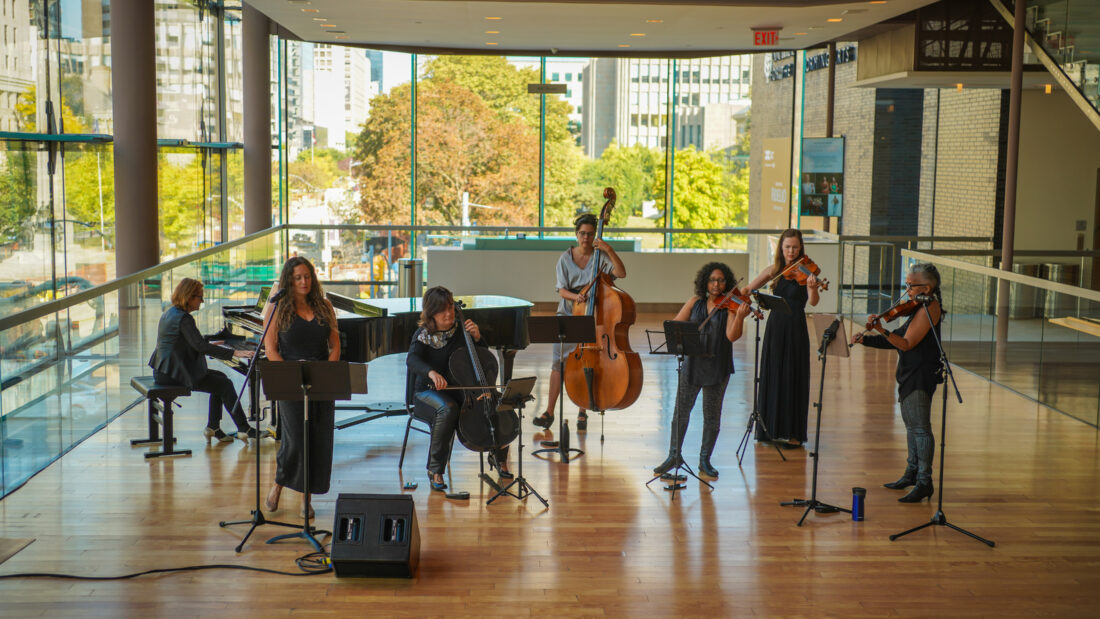
While the music of Solidaridad reflects its egalitarian mandate, the ensemble’s performances are also unfailingly joyful and thoroughly accessible. Last October, at a lunchtime concert for an attentive, appreciably diverse audience at Toronto’s Four Seasons Centre for the Performing Arts, Solidaridad unspooled a dazzling set of songs, including “YYZ,” a cover of the instrumental chestnut by prog-rock kings Rush, which resonates with Halpé because it is the code for Toronto Pearson International Airport, a beacon of home when she is travelling.
The fascinating story of how Halpé found her way to tango and, much later, recruited musicians for her ensemble—which would require a level of commitment far exceeding rehearsals and gigs—begins in France in 2002. “I had gone for a walk in the botanical gardens in, I think, Bordeaux,” Halpé recalls. “I heard this weird music. I walked toward it, and there was this gazebo festooned with roses. Like, literally, dripping roses. Inside, people were dancing tango—Argentine tango, so they were dancing in a close embrace. I love dance. That was my first tango moment.
“I was like, ‘What is that? I want to do that!’ I had also seen Carlos Saura’s film Tango when it played the Toronto International Film Festival in 1998, and I was like, ‘Wow.’ So I started dancing tango. I have been dancing tango much longer than I have been playing it—probably since 2003.”
Halpé had always dreamed of being a professional musician and, indeed, was one in Sri Lanka. She began studying music at age three, aced the violin, and eventually performed with the Sri Lanka Philharmonic. But she found a career in music more difficult to pursue after settling in North America. “My reasons for leaving Sri Lanka were complex. Suffice it to say that my politics and that of the nation were, and are, at complete odds with each other. I left because I could no longer bear to be a witness to the atrocities that were happening.” By the mid-1990s, she was in upstate New York studying at the Hobart and William Smith Colleges. Though discouraged by the quality of the program, she nevertheless completed her undergrad, with a major in English and a minor in music. Unsure of her next steps, she returned to Sri Lanka in June 1996 but found the country still mired in a brutal, decades-long civil war. In 1998, she came to Toronto to complete her master’s degree at the University of Toronto and received her PhD in post-colonial English literature from U of T in 2010. After meeting Sanders in 2013, Halpé decided to stay put in Toronto. By then, she had caught the tango bug and had picked up her violin again.
She started transcribing Piazzolla. “I didn’t know at the time that that’s what all tango musicians around the world do, including the Argentines. It is the foundation of becoming a tango composer. I was transcribing because there was no access to the music, and I just loved what I was hearing. It was completely organic.” Halpé burrowed into the form and made connections with noted players in Argentina such as Guillermo Rubino and Ignacio Varchausky to learn to play tango as it was meant to be played.
“Tango uses the language of classical music—the sheet music is similar to European-based sheet music,” explains Toronto-based producer Michael Phillip Wojewoda, who helmed Solidaridad’s 2023 debut album, Distancia. “But, much like the oral tradition of certain cultures, understanding it comes from a place that is not written down on the page, so ultimately that information is conveyed by studying with other masters. You have to work with people who know the idiom to eventually know how to translate what is on the page.”
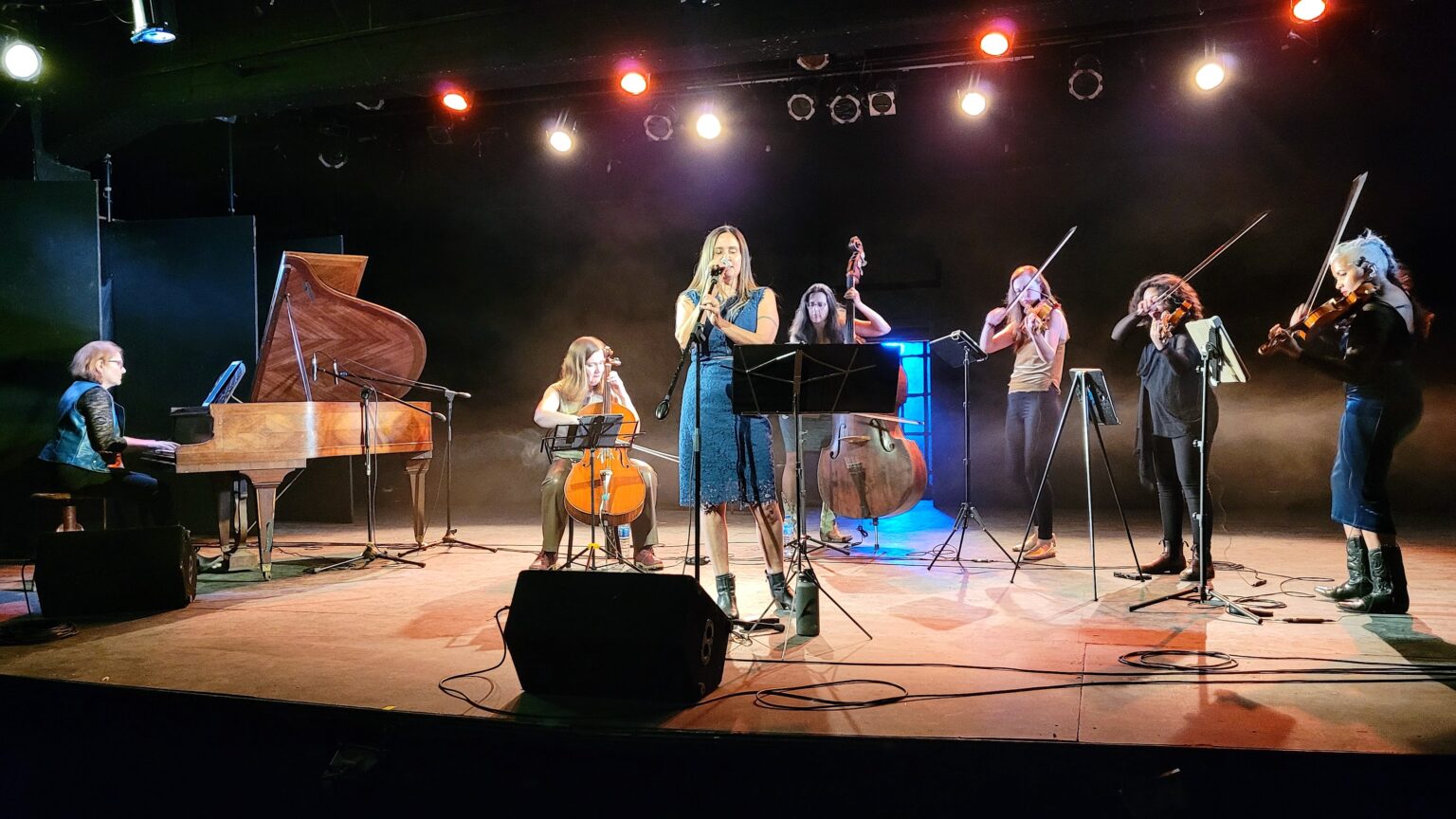
While Halpé’s entrance into tango music happened organically, her assembly of Solidaridad Tango members did not. During the COVID-19 pandemic, she cold-called musicians she had heard of—but had never previously worked with—and tabled an unusual offer. “I’m sure I came across as a crazy person,” she says with a laugh. “I had to say to someone like Esme [Allen-Creighton], ‘I know you have a master’s degree from Julliard and you’re a phenomenal violist, but you’ll have to learn this. You’ll have to learn tango.’
“Many musicians assume tango is just something you can pick up and do, and it’s not. There’s a lot of ersatz tango out there. It’s fine, it flies. But it’s not what I was after. What’s astounding about the women in this group is that, in addition to their talent, they all agreed to take Zoom lessons with Argentine players in Buenos Aires that I paid for,” says Halpé, who had forged many relationships in Buenos Aires when she was learning about and transcribing the music.
Wojewoda—who has produced albums by the Barenaked Ladies, Spirit of the West, Measha Brueggergosman, Sloan, and the Toronto Symphony Orchestra, among others—cut Distancia in two sessions, using Astor Piazzolla’s acclaimed 1986 album Tango: Zero Hour as both an engineering blueprint and a sonic inspiration. “It left such an incredible impression on me when I first heard it back in 1993, and it introduced me to contemporary tango—I basically mimicked it.
“We tried to do the album in a day, but that was too ambitious, and three of the tunes just didn’t work out,” continues Wojewoda, who is married to Solidaridad bassist Shannon Wojewoda. The recording of Halpé’s new, tango arrangement of Rush’s “YYZ” took longer to finesse. It was remotely recorded at Annette Studios when Solidaridad was the ensemble in residence. Wojewoda also cut Solidaridad’s electronic press kit. “The entire recording process was covered by nine cameras, and I made individual films for every song on the record,” he says. “I thought it was a simple, unspoken way of having an audience understand it was an all-female band. I’m hoping these videos will add to the awareness of these artists.”
Awareness is a significant component of the Solidaridad mandate. Halpé raves about her bandmates—bassist Wojewoda, violist Allen-Creighton, violinist Suhashini Arulanandam, vocalist Valeria Matzner, cellist Sybil Shanahan, and pianist Elizabeth Acker, plus acclaimed bandoneon player Eva Wolff, who guested on Distancia—but explains that their placement in the ranks wasn’t a foregone conclusion. “Solidaridad [has] a diversity mandate. That was in my mind when I was putting the group together. Every single position in the band was first offered to a musician of colour. Only if that position was turned down was it offered to someone white. We have a responsibility in the arts to make space for people who traditionally have not had access. My walking away from music was the foundation upon which that idea was formed. I felt that I had no choice, that I had to walk away. Solidaridad, which is Spanish for solidarity, is about creating space and holding space in ways that are safe.”
In 2023, with the ensemble in place, Halpé began to think seriously about recording and touring in Argentina. “Initially, [the repertoire of] Distancia was all over the place,” she says. “But I took the ensemble to a festival in Oregon co-sponsored by the [liberal arts] Reed College and the Argentine non-profit Tango Sin Fin in June 2022, where we had the chance to work with Ignacio Varchausky, who teaches there, as well as other titans of tango. They asked me, ‘What are you trying to say with your album?’ Once I started asking that question, the repertoire choices became clearer, and I became less nervous about putting my own music out there. I had to shelve my doubt and just go with it.
“And I knew the album had to have poetry, because I am a poet,” Halpé adds.
Distancia includes three goosebump-inducing spoken-word interludes—one opening the album, another closing it, and one in the middle—which were written and performed by Halpé and concern contemporary issues such as murdered Indigenous women, land acknowledgement, and pandemic lockdowns. They are yet another deviation from traditional tango that, in the hands of Solidaridad, nevertheless make perfect sense while reinforcing the music’s ability to nimbly juggle elements of tragedy and joy.
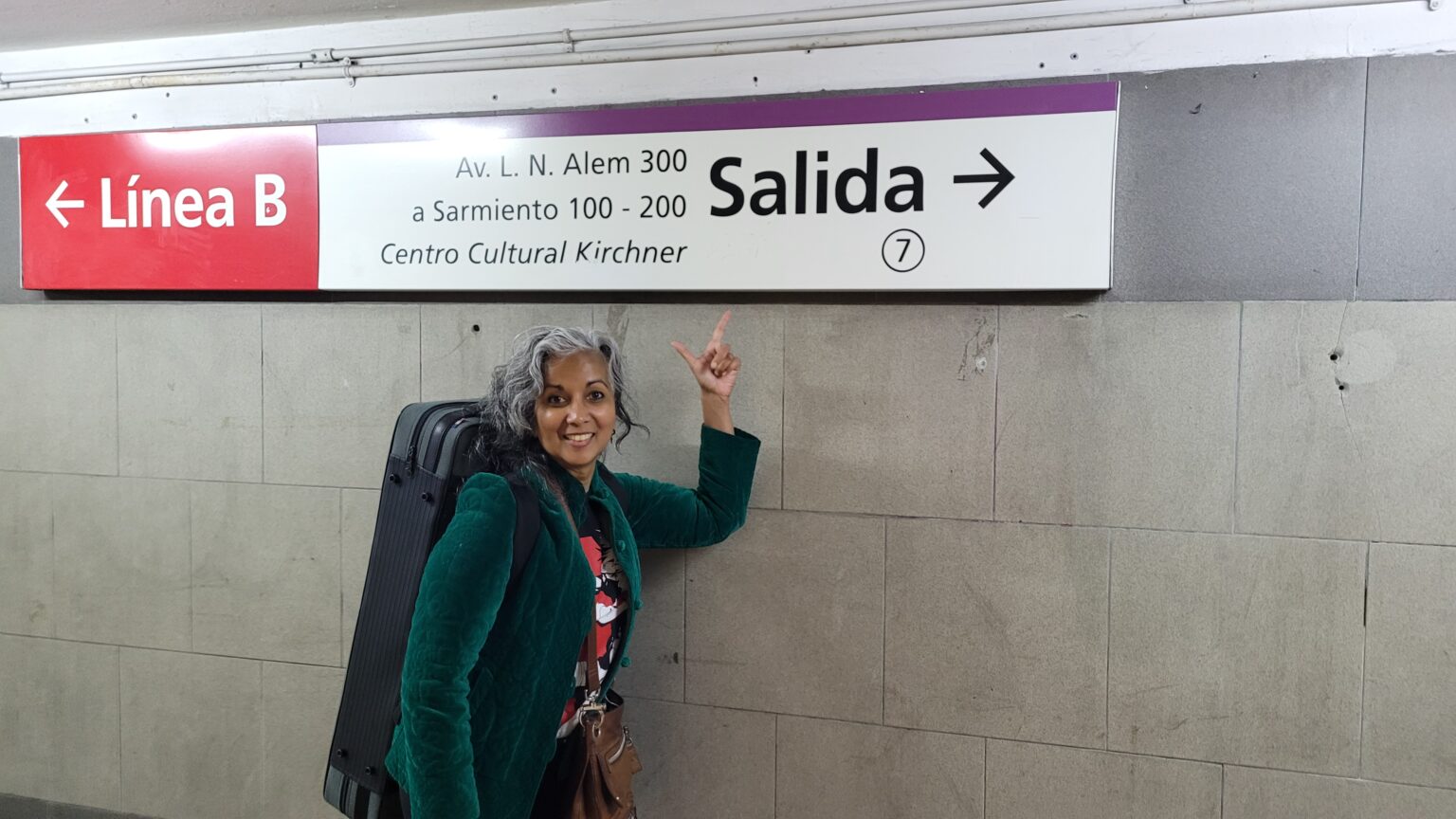
The finished album arrived in May 2023 to ecstatic reviews (“packed with passion and played with perfection,” Songlines UK declared). That left Argentina as the final frontier for the contemporary tangueras to test their musical mettle. So Solidaridad Tango went straight to the music’s heart in Buenos Aires for live dates and some workshopping with local musicians last August.
“We were rapturously received,” Halpé says. “I did not expect any kind of reception. I mean, what the hell? A Canadian, all-female tango band? Why would anyone even show up to listen? I thought we’d be playing to empty halls, and it was the opposite.
“Hardcore tango people were showing up. Young women were showing up. Our music is respectful of tango, but it’s also its own thing, and the audiences deeply appreciated it. There’s a lot of tango gatekeeping in North America,” Halpé says. “There was none of that in Buenos Aires.”
KIM HUGHES has enjoyed a long and dynamic career as a writer, editor, and broadcaster with some of the most prestigious media properties on the planet, covering arts and entertainment for Zoomer, Original-Cin.ca, the Toronto International Film Festival, the Toronto Star, Amazon.com, SiriusXM, 102.1 The Edge, CBC, Report on Business Magazine, Elevate, NOW, The Grid, hmv.com, CARAS, and multiple others. This is her debut Musicworks feature.