
Every performance is a spiritual experience for Tahltan and Tlingit artist Edzi’u, who invites their ancestors to join them each time they make music. Drawing deeply from personal experience and cultural knowledge, their works explore grief, love, and healing. Connecting with their ancestors through intuition, storytelling, and sound is central to their creative process. With increasing global attention to Indigenous rights, Land Back movements, and identity, their next release will no doubt reflect the times as much as their truth.
“I try to place my voice in that space and let that come through,” Edzi’u says. “There is a lot of channelling. It’s something I’ve been taught to do in a traditional sense through traditional dance. I try to bring that into every space—but it’s also just something I’ve always done, even as a child.”
The artist pushes back against conformity and expectations of perfection in favour of expectations of growth. “There’s always fear, but there’s also knowing you have to stay true to yourself and your beliefs, and you can do that,” they say. “I was raised by my parents, aunties, and grandmothers to keep heart, love each other, and speak out—no matter what.”
Edzi’u’s training in classical composition and voice taught them the importance of creating space and silence to convey emotion. They grew up listening to Aretha Franklin, Reba McEntire, and Sharon Van Etten—vocalists who create an epic swell for their dramatic storytelling—and Chicago dance-pop-R&B duo Drama also influenced Edzi’u’s unique, genre-defying style. They consider their entire sound their “voice” (even when not singing), and create narrative-driven, nuanced musical experiences that revolve around atmosphere, texture, and memory.
When we speak, they call from Treaty 1 territory with news that their next recording is in the works, and that it will be more atmospheric and introspective than their previous releases Potlatch in the Box (2023) and Tunnel Vision (2024).
“The sound [of Tunnel Vision] was crowded, dense—that’s where my head was. I had a lot going on in my mind and in my heart. With this next one, I want to say, ‘We’re here now. There’s more room. There’s more space. What’s the next step?’”
Edzi’u’s narrative intention is especially vivid on Potlatch in the Box, a sound-art concept album structured like a potlatch. Cultural feasts that include speeches, food, song, and gift-giving, potlatches were banned in Canada from 1884 to 1951 as part of a broader effort to destroy Indigenous ways of life. Each track on Potlatch in the Box represents a different stage of the event.
“I thought, ‘Where would we be eating? Where would we be talking about the land?’ I tried to place each track within the timeline of a potlatch,” Edzi’u explains. “Potlatch is who we are as people. We use potlatch to celebrate, to grieve, to love, to mourn, to create, to destroy. So it was the perfect format to talk about colonialism—about the ban, about residential schools, about contact—but within a capsule.”
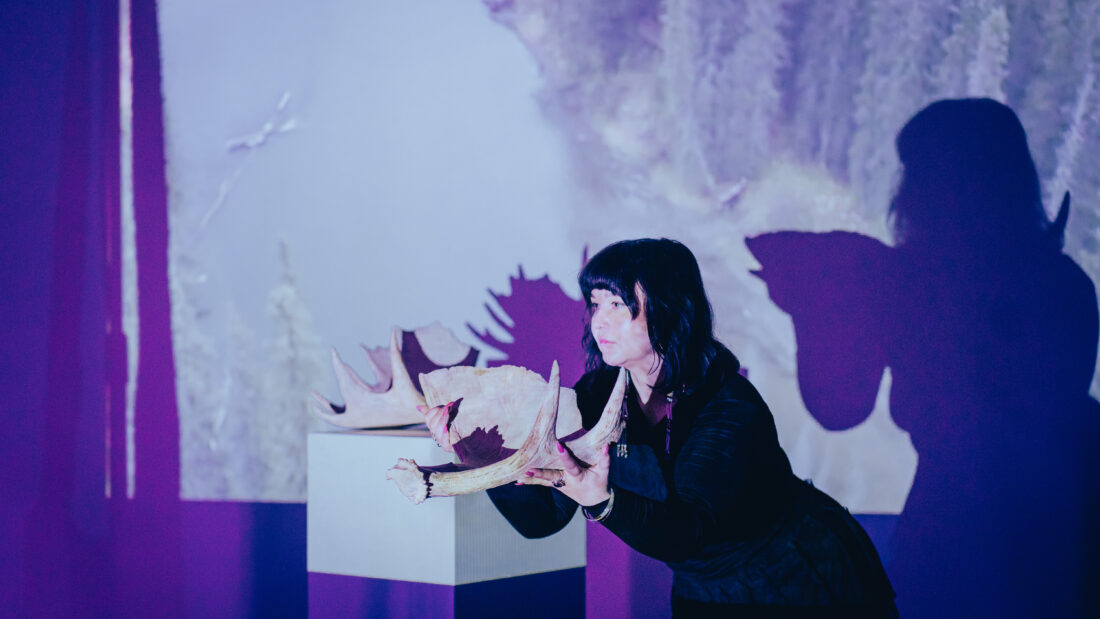
“The Moose Are Life,” an eleven-minute song on Potlatch in the Box, is also a visual sound installation that debuted in Vancouver at the 2019 Collisions Festival (by the now defunct Curiosity Collider). It was presented again in April 2025 by New Works Calgary, this time including live performance activations and a guided walk.
The piece features video footage of a moose running that was recorded by the artist’s father, projected with purple wash lights and accompanied by a recording of him explaining the significance of moose to the Tahtlan people: “When my aunts or dad or mom would drive me to our territory, to my grandmother’s place … there was one place in particular right outside the rez, on the way to Dease Lake in this little mushy bog area. We would get out, wait for a few minutes, and see a moose in that spot every single time we would drive in, and I haven’t seen a moose there in that spot for years …. We’re seeing a lot of the moose disappear, and the province has said the moose numbers are up, but we don’t see them in the places that they used to be.”
For Edzi’u, music is an offering—rich in emotion, storytelling, and intention. Their next record promises more of that energy, but with new dimensions. “I don’t go into things with narrow expectations. I believe that songs are living, sacred beings, and they evolve in their own way. I’m simply there to carry them forward, and however they show up is how they’re meant to be, especially with a concept album like Potlatch in the Box.
“It was meant to be a vessel for voices on the impact of colonialism today, echoing from the past until now, and in a futuristic sense.”In the works is a reimagining of Potlatch in the Box as an immersive gallery installation featuring projections, materials, and audio elements. With “The Moose Are Life” as the prototype, the new work will remix tracks into snippets, expand on the original album, and continue calling attention to Indigenous experiences, sovereignty, and culture.
ALY LAUBE is a writer, communications specialist, and musician living on the traditional territory of the Tsleil-Waututh people.