
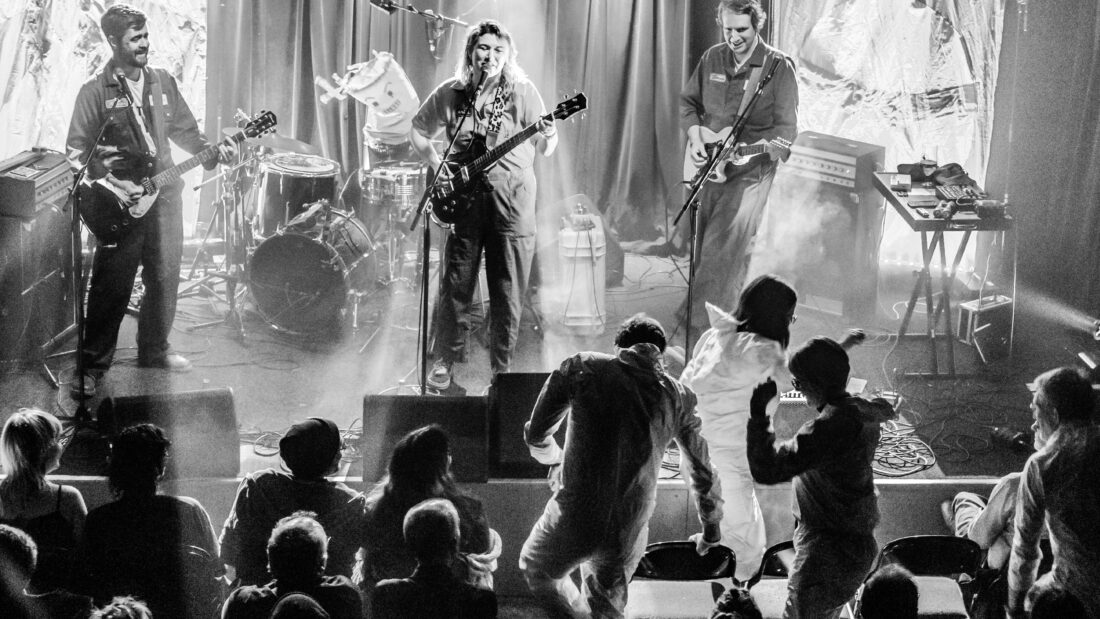
It’s impossible to pigeonhole the music of The Burning Hell. Their songs span multiple genres, and the lyrics can be apocalyptic, political, and funny. The band’s off-the-grid DIY ethos is guided by the core of singer-songwriter-multi-instrumentalists Mathias Kom and Ariel Sharratt (a third member, producer and musician Jake Nicoll, is currently on parental leave). They record and manage themselves; book their shows; make their own visuals and videos; invent and build instruments, like the robot drummer created for the tour of their 2024 EP Hardly Working; grow vegetables on their P.E.I. farm; and record music in a solar-powered camper van studio. They collaborate with like-minded musicians such as Steve Lambke, who runs You’ve Changed Records, which released the band’s 2022 album Garbage Island, Shotgun Jimmie (stage name of singer-songwriter Jim Kilpatrick), Kelly McMichael, and Maria Peddle.
The Burning Hell began in the early 2000s as Kom’s home recording project. Shortly after Sharratt joined in 2010 as a touring musician, she and Kom formed a musical and life partnership. “I recognized Ariel as someone who was on the same page,” says Kom, sitting in a Toronto café on the eve of their performance as a duo at Toronto’s Hugh’s Room. “We could read each other’s minds, and now I couldn’t imagine making music without her.” Song by song, fan by fan, and show by show, they have built both a career and a community, touring small venues across Canada, the U.S., Europe, and Australia, making friends and connecting with listeners through live shows and an online Patreon community where Kom shares his thoughts on songwriting, performing, and gardening. And they’ve built all this largely outside the music industry.
“We have to dance with the industry in some ways, but we’re self-managed, and have been self-booked until recently,” says Sharratt. “Part of that came from seeing people who can have creative control of their projects and make them sustainable because they’re doing everything themselves. It’s a lot of work, but it’s made us pretty dynamic.”
In Berlin, they met a student who ended up booking the band in Europe for several years. “He had a real interest in music and a brain for spreadsheets, and he loved doing research and finding interesting little DIY spaces all over Europe,” says Sharratt. “He booked us on a three-month tour of Europe in 2010. We played a comics festival in France, a squat in Zurich, and cafes all over the place. It all started with one fan.” The band has grown alongside their collaborators, she says. “We work with people that we believe in or find inspiring. It’s not all rock clubs with security guards, it’s a lot of DIY spaces, and that’s made the project sustainable and helped us have a long touring career.”
“A lot of people are realizing that the old frameworks don’t work anymore, and that the way to do it is to make sure you’re always prioritizing your creative vision,” says Kom. “It comes down to finding happiness and meaning in what you’re doing, rather than worrying about numbers or expectations.”
The newest Burning Hell album, Ghost Palace (released March 2025), calmly addresses environmental devastation and the end of the world with lyrics of dark wit couched in beautiful, even jaunty melodies. This strange and appealing dichotomy is shared with previous releases Revival Beach (2017) and Garbage Island. “[Those albums] were our first explorations of talking about the end times in a playful but serious way,” Kom says. “Ghost Palace is about what we leave behind. It’s about memory and nostalgia, about Earth after we’re gone. The image is that of an abandoned resort on an abandoned planet where memories live. And those are the ghosts, I guess, or we are.
“I’m interested in narratives about the apocalypse and the human obsession with the end of ourselves,” he continues. “I find it fascinating that we’ve been talking about this for thousands of years, and now we’re experiencing some real, measurable signs of collapse. Sometimes I think, how can anybody write about anything else?”
“My Home Planet,” “Summer Olympics,” “Duck vs Decorated Shed,” and “Luna FM” are high-energy pop-rock songs featuring all kinds of instruments, styles, and lyrics that are packed—like all Burning Hell songs—with references to bands, movies, food, and pop culture. “Birds of Australia” and the title track are wistful and sweet and folky. They all have devastating images: cars full of skeletons, plastic in the water and the clouds, skin getting crispy in the oppressive heat. And yet they sound … joyful.
“I love listening to melancholy music, but the music I want to make is always joyful,” Kom says. “There’s joy to be found even in the darkest narratives about what we’re doing to ourselves. As long as we can make music, and have the ability to connect with each other in a creative way, there’ll be joy.”
While Kom handles most of the songwriting, Sharratt works with him on melodic, sonic, and conceptual ideas. “We try to create a cohesive album with some kind of narrative structure, so we’re figuring out how that will work and the images we want to put together,” says Sharratt, who gets ideas by walking and singing into her phone. “We live far from anyone, so I can walk on the trail singing to myself. I don’t have ideas sitting down, but as soon as I’m walking, I have a million. So I take the voice memos and figure out how I’m going to structure the song or what chords will work with the melody, and that’s what I find interesting, putting things together.”
“It feels like a perennial discovery, how to go about writing songs,” Kom says. “Sometimes playing piano or guitar will bring something out, but it’s about getting into the right headspace and relaxing.
“Ariel will have musical ideas that would never occur to me,” he adds. “She’ll hear something I did not consider, and that’s exciting. I get writer’s block, but I’m good if someone gives me an assignment, as Ariel often does.” For Ghost Palace, Sharratt suggested Kom write a song about a radio station on the moon (“Luna FM”).
While making Garbage Island, COVID-19 restrictions kept producer Nicoll in Ontario, and Sharratt and Kom in St. John’s, Newfoundland. They ended up recording at home and sending tracks back and forth. “That more drawn-out process has had a real impact,” Sharratt says. “We’ve had more ideas come and go, and the songs live for a longer time in production. It’s brought more thought, more time, and we’ve gotten more conceptual, both sonically and in terms of narrative.”
When the time came to mix the album, Nicoll retrofitted a ’70s camper trailer into a solar-powered recording studio and, after the lockdown lifted, brought it to Kom and Sharratt’s P.E.I. farm. “It spawned a new direction in terms of thinking about production in a more sustainable way,” Kom says. “It also gave us access to acoustic environments that we wouldn’t have had otherwise. Because it was totally off-grid and mobile, we took it to abandoned farmhouses, a lighthouse, and other places, and that was eye-opening and exciting.” Nicoll’s mobile recording trailer, christened The Scamper, was used at the 2022 Sappyfest (in Sackville) and the 2023 Hold Fast Festival (St. John’s), for Phonoautomat, which Sharrett describes as “a community recording project inviting people into a small, well equipped studio to record five minutes of material, [which] is immediately mixed to four cassettes while participants create art for their tapes outside.”
With each album comes a process of world-building that includes making non-musical things, Sharratt explains. For the “Bird Queen of Garbage Island” video, she crafted a garbage island and puppets, and she and Shotgun Jimmie made quilted backdrops for shows. She also hand-sewed the cover image for Ghost Palace. “We spent so long not playing shows that now I feel like I want them all to be special and fun, and create a little world around the music,” she says. “That’s an inspiring thing that came out of not touring.”
While Kom is the band’s main vocalist, he and Sharratt both sing and play multiple instruments: guitars, woodwinds, and drums for her, keyboards, drums, banjo, and guitars for him, and bass—which they agree is the best instrument. While Nicoll stayed home with his family, Maria Peddle joined them on violin, bass, and drums for their January 2024 tour of Australia, where they also worked on a collaborative project with poet and performer Tanya Davis and composer Carlie Howell inspired by island ecology and adaptations to isolation. They’ll have a full band when they tour Europe this spring.
“We never expect anyone to come in and just play the parts on the record,” Sharratt says. “We approach the songs as living, breathing things, especially on the road. We’re not interested in replicating things; we’re interested in people bringing new ideas.”
Mary Dickie is a Toronto music and arts journalist whose work has been published in a variety of different publications over the past couple of decades, including Impact, Eye Weekly, Maclean’s, ELLE Canada, The Toronto Sun, FASHION magazine and IN Toronto. She is also a member of the Polaris Music Prize jury.