
Wayne Lavallee has taken an adventurous creative path to reach his latest milestone: writing music with fellow Vancouver musician Jesse Zubot for filmmaker Marie Clements’ Bones of Crows, one of the largest Indigenous-led production in Canadian screen history. Lavallee grew up in residential schools and foster care and left home to start working at age sixteen. He initially struggled to make a living in music. Then an ad in a Vancouver paper introduced him to the burgeoning Indigenous arts community. He worked in theatre for most of the 1990s, then returned to music in the 2000s, releasing three albums and garnering Juno, Canadian Folk Music, and Canadian Aboriginal Music awards or nominations for Green Dress (2004) and Trail of Tears (2009). A new avenue for expression opened up in 2014 when Clements invited Lavallee to create music for a short film. Subsequent film projects—many with Clements—have allowed him to expand his skills and sonic palette.
Bones of Crows tells the story of a Cree woman who survives the residential school system, becomes a code talker during the Second World War, and fights alongside her siblings and descendants to build a more just future. In February 2023, Lavallee, Zubot, and Clements (as lyricist) received a Canadian Screen Award nomination for Achievement in Music–Original Song for “You Are My Bones.” More recently, the film received thirteen 2023 Leo Award nominations, including Best Musical Score, for achievement in British Columbia Film and Television. (Leo winners are announced in early July 2023.) Bones of Crows opened in Canadian cinemas in June 2023. In the fall, Bones of Crows will premiere on CBC-TV as a five-part mini-series (the format for which the story was first developed) during the 2023–2024 broadcast season. The series version extends and deepens the stories of the characters and, of course, includes plenty of additional music.
In September 2022, a week before the world premiere of Bones of Crows at the Toronto International Film Festival, Wayne Lavallee shared some of the highlights and turning points of his musical journey with Musicworks editor Jennie Punter. Their conversation has been edited for length and clarity.
I see that you wrote music for some of director Marie Clements’ earlier films. How did you get started in music and score composing—did you gradually move into film?
I’ve known Marie for thirty years. We go back to our theatre days in the early 1990s, when I was involved in the Spirit Song Native Theatre Company in Vancouver. It was part of a really tight, small community that was the hub for Indigenous arts and the socio-political scene. Everybody was getting into or wanting to understand their place within our worldview.
I was part of that ’60s and ’70s Scoop that happened—we went to a residential school, and then we got fostered out. I wasn’t raised with my culture, but I was raised with music. Music helped me go through that whole foster home experience—because it wasn’t a positive one, it was pretty harsh and abusive. Music pulled me through. I was going to be in a rock band; that was my goal, and I held on to that. Because I wasn’t raised in my culture, there was no sense of pride in it, and there were no Indigenous role models for me. I wasn’t aware of any singer-songwriters at the time. There was just, you know, Led Zeppelin!
I left home at sixteen and was on my own. I had to leave school, and I started working in construction. I was couch-surfing and figuring out how I was going to make this music thing work. I had taken guitar lessons when I was young, so I was pretty good. And I could sing, but I was still very shy.
I had done a lot of theatre in Vancouver, and I started dabbling in film as an actor. There I was, trying to find my own power as an Indigenous youth, and my agent was saying, ‘Hey, dress up like this.’ It was degrading. I decided to quit acting altogether and start focusing on music as a singer-songwriter. And I ended up releasing three albums.
What was your first experience creating music for a film?
Marie did this short film about Tom Jackson for the 2014 Governor General’s Performing Arts Awards (Ballads Not Bullets: Tom Jackson). She asked if I could do some music for a clip. Then she asked me to do music for a docudrama (Number 14, 2015), and then suddenly I was working on music for Marie’s first feature documentary, The Road Forward (2017). It was huge, and it was very successful. That documentary got me my first Leo nominations. The same year, the National Film Board [asked me to write music for] this other short documentary [Jay Cardinal Villeneuve’s Holy Angels].
I learned along the way. I knew music and melodies, and my theatre background helped me understand film story—music as an extension of the characters’ emotions.
Is the guitar still your primary instrument, or are you using keyboards and other methods?
It’s changed over the years. I’m a vocalist. I do a lot of stylized chants. I’m using keyboards and pads, but I might start with guitar. But now I have totally moved into a different realm with Bones of Crows. I moved into working with strings and composing symphonically for the first time.
I worked with Jesse Zubot (a longtime member of Tanya Tagaq’s band and founder of the Vancouver-based Drip Audio label). Strings are his thing. He works with his strings on a very spiritual plane. Jesse and I have known each other for twenty years. He recorded on a couple of tracks on my last two albums. We’re both at a place where we’re film scoring, and now we’re collaborating. He’s bringing these strings, and I’m bringing in these additional flavours, and we’re melding them, going back and forth, and creating this world.
How has your journey as a music artist intersected with or been influenced by your personal journey? Is there music from your culture that you’ve taken in or explored?
I only discovered Buffy Sainte-Marie in the ’90s. When I heard (’90s folk-rock duo) Kashtin for the first time, I thought, ‘Wow, these are brown dudes, singing on MuchMusic, and everybody’s digging it. I don’t know what they’re saying, but they’re rooted in their culture.’ That’s what I wanted to do. At the same time, my experience in Spirit Song theatre helped me understand my history, why I grew up the way I did. It gave me a sense of learning and pride, and opened up my world to the Indigenous arts scene.
Even though I wasn’t raised with singing and drumming, I made it my own, I picked it up. My dance is my own. I learned how to sing powwow and the West Coast style of chanting. Then I explored the more contemporary side of the Indigenous arts and contemporary dance. For Bones of Crows [we] wanted to create this contemporary world of music—strings and guitar, and these stylized chants, and mesh them into a palette of sound. This can be a powerful expression of storytelling. And it lent itself beautifully to the film. Bones was the next level for me.
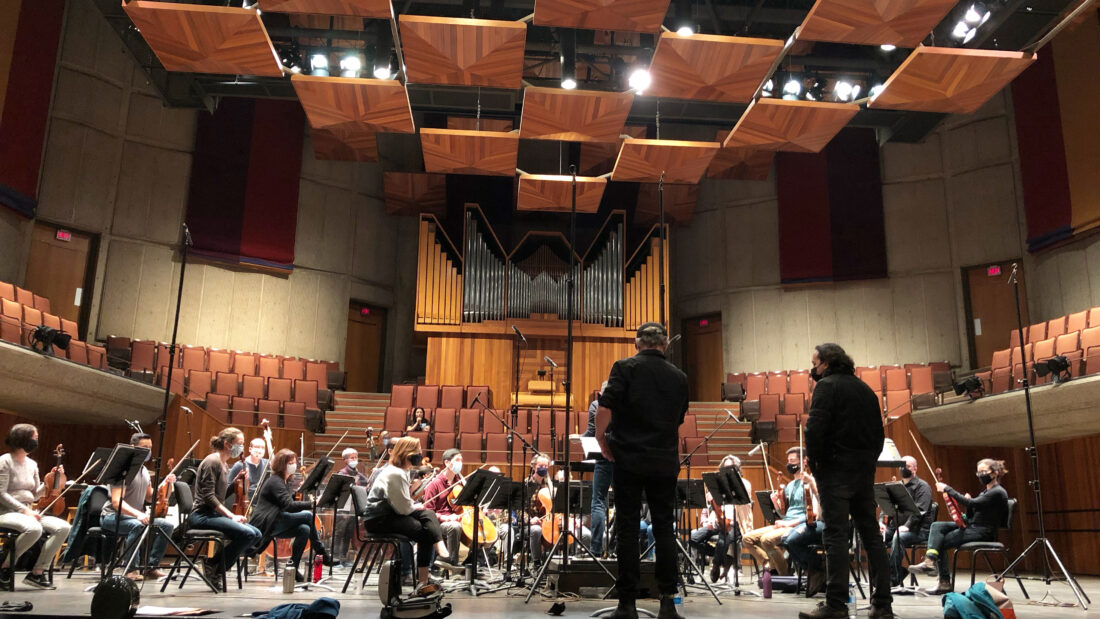
Every time I do something I’ve never experienced before, I want to dive into the next thing. I’ve never scored for a symphony orchestra before, and suddenly I have my orchestra software laid out, and I’m doing parts. Recording the score for Bones was the first time I saw and heard my music played by an orchestra [the Victoria Symphony]. Besides the strings, we’re also hearing the vocals emerge out of it, the styles of chanting. When you hear that, it grabs you.
For so many years, we weren’t telling our own stories from our own perspectives. We didn’t have Indigenous directors or writers or score composers. I’m interested in doing this work because there are not a lot of us creating these kinds of scores right now.
Jennie Punter is the editor of Musicworks. For more than two decades she has written regularly on music, film, the arts, and the entertainment business for Variety, The Globe and Mail, and the Toronto Star, and has worked for or contributed to many other Canadian and international publications. For a dozen years, she maintained a parallel career as a documentary-film field producer, researcher, and writer; she has worked on film and digital projects for award-winning organizations such as the National Film Board of Canada, Storyline Entertainment, Sphinx Productions, and 90th Parallel. Her music and film journalism is included in various anthologies, most recently Leonard Cohen On Leonard Cohen: Interviews and Encounters (Chicago Review Press, 2014). She studied classical piano for fifteen years.