
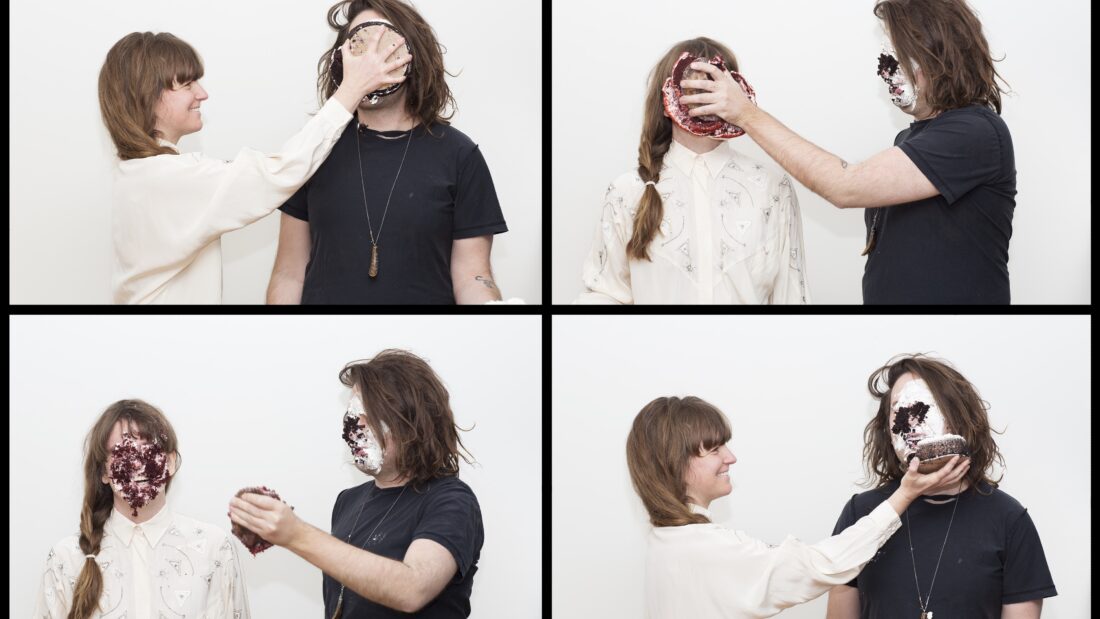
In late March, Felicity Williams and Andrew Zukerman found themselves in a familiar place—the Main Hall of Toronto’s Tranzac Club—doing something they haven’t done before: performing live as the experimental electronic–folk act You Can Can.
Zukerman is an audio and visual collage artist who releases music under the Fleshtone Aura moniker and collaborates with Badge Epoch, and Williams is a vocalist with a jazz background who’s best known for being a member of Bernice and Bahamas. Both musicians are active in Toronto’s avant-garde music scene and can often be found performing with their peers at the Tranzac. Zukerman is also the bar manager of the Tranzac, where the pair first met in 2019.
“I’m going to be worried until the moment it’s over,” Zukerman said in an interview held a few weeks before You Can Can’s live debut.
In an email, Williams assured me they would find a way to evoke the spirit of the album. “I’m excited about the potential to weave the electro and the acoustic elements in all kinds of permutations. This show will be more of an experiment than a demonstration of the record, and I hope it will be the first of many.”
You Can Can’s self-titled album debut was released in early March 2023 via Séance Centre, but the pieces themselves came together during the pandemic lockdowns of 2020 and 2021. Williams and Zukerman received a Canada Council for the Arts Digital Originals grant and began working on their collaborative process. “Since we come from two different disciplines, it took a lot of massaging to find our mode—and a completely different approach on both our parts to arrive at what we arrived at,” said Zukerman.
In terms of musical sensibilities, there is both an affinity and a dynamic of opposition between Williams and Zukerman. “During the long days of the lockdown, I would spend hours recording vocal layers, nitpicking and crafting harmonies down to their minutiae,” Williams explained. “Then I’d send them to Andrew, and he would disfigure them (almost) beyond recognition. His instincts are toward playfulness, absurdity, comedy, deconstruction. Whereas I can become preoccupied and narrowly focused while developing a musical or lyrical thought, his commitment to not taking anything too seriously has a refreshing effect on our process. That’s not to say that he isn’t attentive to detail, but his way of attending to detail isn’t fraught or stressed out.”
Zukerman’s approach to the album, and to sound in general, is informed by his visual arts practice, which is collage. “I try to make it so granular that rearranging the pieces can create its own logic outside the bounds of the original source material,” he said.
You Can Can is Williams’ first release as a primary lyricist. She found inspiration in a diverse selection of texts, including Clarice Lispector’s novel Near to the Wild Heart (translated by Alison Entrekin), James 1:23-24 (the New Testament of the Bible), and various interviews with poet Ben Lerner about poetry as “a record of failure.”
“Failure Figures,” written before the pandemic and influenced in part by the writings of philosopher Slavoj Zizek, best exemplifies the beautiful counterbalance between Williams’ lyrics and playful melodies and the assemblage of instruments. “I was inspired by Zizek’s discussion of the radical contingency of reality—this idea that nothing is determined in advance, our actions matter, agency is real.
“There’s something comforting in the assurance that we will fail,” she noted. “I watched a bunch of interviews with [saxophonist] Wayne Shorter, and one thing that struck me was when he said he was becoming increasingly convinced there was no such thing as a mistake: ‘I think what we call a mistake is actually a start.’ Failure prefigures the conditions for a new direction.”
Zukerman and Williams brought Toronto-based musician and producer Sandro Perri on board to master the record. Perri is familiar with both artists, having mastered a few of Zukerman’s Fleshtone Aura releases and produced some Bernice records, and was well suited to the project. “He is really sympathetic to our [creative] direction, and he also makes such wonderful music, so you can trust that that level of refinement and taste is already there,” Zukerman said. “You don’t have to question him at any time.”
The electroacoustic music on You Can Can is highly detailed. Hissing and glitchy layers of tape loops, guitar, synths, piano, handbells, and field recordings fold together, while Williams’ sparkling, and often disembodied, voice skates overtop. These collagist tracks are also filled with memories: Zukerman frequently carries an audio recorder during the day to capture sounds, and You Can Can includes recordings from a trip he and Williams took to Mexico and from a cottage they rented with friends.
“Some of the more prominent [field] recordings in there have a twinge of the sentimental, at least for me,” says Zukerman. “There was one afternoon of torrential rain at the cottage. To the casual listener it’s just rain, but to me it [is] the time I took shelter under this dilapidated shed, and the tin roof had a certain timbre to it that only I will recognize.”
Although Williams and Zukerman assembled You Can Can in relative isolation, sounds from friends and collaborators are integrated into the music. “Failure Figures” features Daniel Fortin on bass and Thom Gill (Bernice) on guitar and synthesizers. Some of the instruments heard on the record were borrowed from friends: “Everything in Time” includes a nylon-string guitar that belonged to the grandfather of photographer Claire Harvie; the duo made samples using the piano that Robin Dann (Bernice) learned to play on as a child; and multidisciplinary artist Christopher Willes’ handbell set “unveiled a world of tonal possibilities,” Zukerman said. On the Tranzac stage, Williams and Zukerman stood close to each other, hunched over various electronics. Collaborators like Gill, saxophonist Brodie West, bassist Josh Cole, and percussionist Phillipe Melanson gradually joined them. At one point, Dann emerged from the audience to vocalize with Williams. You Can Can was transformed into a living musical collage, with album tracks reimagined by the duo’s artistic community.
Laura Stanley is a freelance writer from Toronto. Her writing has appeared in NOW, Bandcamp, She Shreds, and Under the Radar. She was an editor of the now-defunct Canadian music blog Grayowl Point and is currently the folk and country editor of Exclaim! magazine.