
On March 29, 2022, a fifty-three-minute episode of the Public Broadcasting Service series Frontline took on one of the biggest political stories the United States has seen in decades. “Plot to Overturn the Election,” produced in partnership with ProPublica, exposes the forces behind the January 6, 2021, attack on the United States Capitol and includes forty-nine minutes of music—a soundtrack that isn’t meant to be noticed. At the beginning of the program, a single tone pulses, fading in and out. ProPublica senior reporter and Frontline correspondent A. C. Thompson’s narration is understated, nearly a whisper, while the string harmonics and soft bells of the score are barely audible—which, of course, is the point.
“You shouldn’t really hear the music,” said Jordan Dykstra, who wrote the score. “There are moments, there are cues, but, really, it should just be vibes.” While that may make it seem like the composer does not want to be noticed, listeners are, in fact, a direct consideration in much of his chamber music and his film-score work in features such as Bridget Savage Cole and Danielle Krudy’s Blow the Man Down (2019) and Trey Shult’s It Comes at Night (2017) and in documentaries such as Nina de Vroome’s Globes (2021) and Penny Lane’s Hail Satan? (2019).
“Plot to Overturn the Election” director Samuel Black requested music that was more searching than driving, explained Dykstra, who wrote and submitted twenty short pieces before seeing any footage. As the video came together, the music was reworked both by him and by the show’s editors. “I prefer to get involved as early as possible in the film, so the editors can use my original music to edit to, but that just isn’t always possible because of financial or timing issues with other projects,” he said. “For TV, the process is insanely quick, and I was expected to act on emails I received at 10 or 11 p.m. when the deadline got close. In fact, I was working until late on the Saturday before the Tuesday when the episode aired. On films, usually music is finished a few months—or even longer—before it is distributed to the public.
“For this more dry and non-poetic investigatory kind of documentary, there is a lot of improv at the beginning, but as the editing structure gets solidified—or really, the director falls in love with one of the cues—the changes end up being really small but quite specific,” he added. “At times they were asking me to move one single note around and move events by one frame, of which there are twenty-four per second, so it was quite tedious.”
Dykstra grew up in Sioux City, a small city in Iowa, and spent time on the West Coast studying at the California Institute of the Arts in Los Angeles—where composer Michael Pisaro-Liu was his advisor—and earning his Performer-Composer Bachelor of Fine Arts in 2016. He moved east to Connecticut to attend Wesleyan University, where he pursued both course work and private lessons with Alvin Lucier and received a Master of Arts in Music focusing on experimental composition in 2018. The music of both Pisaro-Liu and Lucier demands considerable focus on the part of listeners; those two composers’ common economy of scale, characterized by prolonged tones and isolated events, is evident in Dykstra’s concert music.
In his music for screen, Dykstra courts a different sort of intensity. For Nina de Vroome’s 2021 documentary Globes, an artfully shot and constructed piece about the work and lives of bees, he paired slow, dissonant strings with joyful scenes depicting little insect dances. Wandelweiser composer Eva-Maria Houben was, he told me, an inspiration. “[The music] is very textural, very tactile. I was taking one single note and letting that live for a pronounced amount of time. It’s more of an audio sculpture, like, Oh, this chord is great. Let’s play it again!”
The score for Blow the Man Down—a dark yet unexpectedly charming murder story set on the coast of Maine—is approachable as music in its own right. The film is strangely light-hearted despite its violence, and the score follows suit. Peppered with shanties supplied in striking on-screen sequences by American folk musician and singer David Coffin (a specialist in sea shanties) the soundtrack achieves a mannered suspense, with passages that border on chamber pop.
Dykstra worked on the score with former Dirty Projectors drummer and frequent collaborator Brian McOmber, building improvisations on keyboards and viola and eventually writing lead sheets that guided further impromptu extrapolation with additional musician friends. While certain moods are determined at the outset, it’s only in the editing that the musical fragments are paired with specific scenes. “It’s a lot of play and improvisation, which is really fun, but it takes a long time,” Dykstra said. “It’s great because we can throw sketches back and forth and make something we couldn’t have done individually.” At the time of our conversation, Dykstra and McOmber were working on music for Fair Play, director Chloe Domont’s first feature, and a documentary about ICE border police by Frontline director Rick Rowley, with whom Dykstra has previously worked.
The influence of Alvin Lucier can be heard through much of Dykstra’s work. Although Lucier (who died December 1, 2021, at the age of ninety) had retired by the time Dykstra got to Wesleyan, he sat on the younger composer’s thesis panel. Dykstra often visited Lucier’s home, where the two experimented with microphones and electronics. In 2022, Dykstra released Out of Our Hands, which features works by himself and Lucier performed by his ensemble Ordinary Affects, on his Editions Verde imprint.
More recently, Dykstra has forged a relationship with Czech composer Petr Kotik, the founder and artistic director of the longstanding SEM Ensemble, who has included Dykstra’s works in his concert programs in New York City and in the Czech Republic, where he oversees the Ostrava Days institute and festival. “I didn’t think much about his music,” Kotik said in a gruffly endearing manner, when asked about his first encounter with Dykstra’s work, which came in response to a call for scores. “I thought, Here is a person who has an idea about doing music in a certain way that is not an effort to please somebody or confine himself to something established. Those are the criteria I use when I encounter work by somebody of whom I have never heard before, which is usually somebody young, and who does something that is hopefully more confusing than anything else.”
Kotik quoted Czech author Milan Kundera to illustrate the value of this confusion: “Man proceeds in a fog. But when he looks back to judge the people of the past, he sees no fog on their path. From his present, which was their faraway future, their path looks perfectly clear to him, good visibility all the way. Looking back, he sees the path, he sees the people proceeding, he sees their mistakes, but not the fog.”
Kotik continued, “The way I would characterize Jordan is that there’s always some idea that is interesting. Then, of course, comes the question of the ability to carry out those ideas. What is interesting is this ongoing importance of conceptuality.” Like the avant-garde composers of Kotik’s generation, Dykstra often leaves things in the score for the performer to figure out. He likes to create little problems—the sort that intrigues a conductor like Kotik.
“I try to make sure that the performer knows that I’m thinking about them,” Dykstra said. “I try to add elements to the score so that the performer is involved in making the music, leaving it to them to figure out how to make it musical.”
Dykstra describes his scores as one point of a triangle, the other two being the performer and the listener. “The performers are interpreting it, and the audience is listening to it and often not privy to the score,” he said. When pressed, he explained that the audience’s role isn’t a passive one. “I think they’re involved in the performance more than they think—it’s not that dissimilar to stand-up comedy.”
Cinema audiences can affect the way the score is received, as well. “If someone laughs, that changes the scene drastically. The social dynamic of an audience interacting with art—it’s all about flow of energy.”
Dykstra finds himself at the musical intersection of the TV room, the movie house, and the concert hall and, for now, is keeping them as separate endeavours.
“I’m having a blast.”
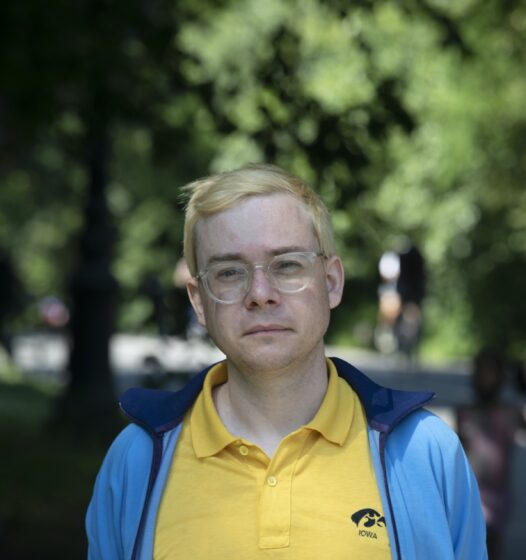
Top photo of Jordan Dykstra by Vc Xi.
LEARN MORE ABOUT JORDAN DYKSTRA.
FYI: Apartment House premiered Jordan Dykstra’s Globus (for violin, viola, clarinet, and piano) on September 6, 2022, as part of its residency at Cafe Oto in London, U.K.