
In the past decade, the English label Another Timbre has provided a remarkable wealth of music, some 125 CDs that focus on post-Cage, postminimalist composition and improvisation. These three recent releases have a shared emphasis on minimalism and the guitar, both an instrumental focus and a sense of reverie—music as daydream and mystery.
Composer Bruno Duplant’s two-CD set includes a CD of three chamber works performed by the Suidobashi Chamber Ensemble of Tokyo. One piece is entitled All That I Learned and Then Forgot, another Where Our Dreams Get Lost: each is a tenuous epiphany, and a record of the elusive miracles and disasters of consciousness and memory. The former is a sea of wandering pitches and timbres, a gentle, shifting fusion of violin and viola, bowed guitar, low reeds, and electronics (the bassoon, especially, suggests a harbour); the latter reduces linear movement and moves the pitch range higher. The third piece, A Place of Possibilities, the most dreamlike of all, contrasts individual instrumental voices against a gritty drone of violin, bowed mandolin, harmonica, and female voice.
Duplant’s second disc in the set consists of Letter to Taku (Field Music for Guitar), in which the veteran experimental guitarist Taku Sugimoto plays the forty-four-minute piece in a Tokyo park alive with birds, insects, children, and other sounds. Each listener will make their own relations; for me, the spare guitar score (the title suggests notes from A to G, their rhythmic position and recurrence dictated by an unpublished letter) is a conduit between the listener– performer and the dense, unhurried life of the park.
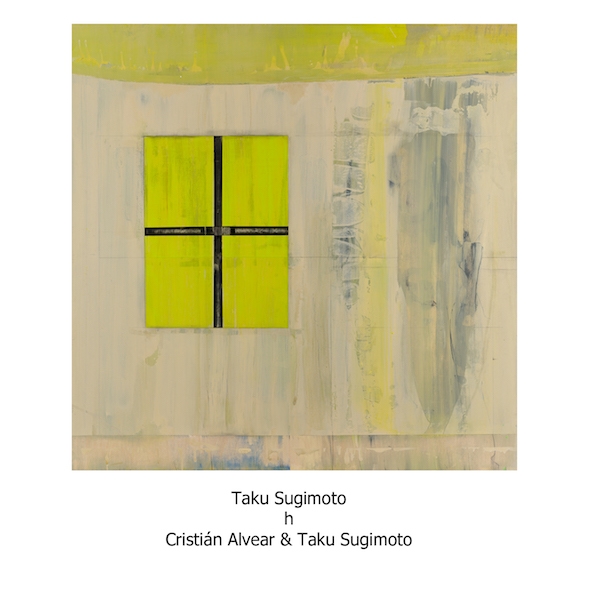
Sugimoto’s own CD is devoted to his composition H, Version for Two Guitars, from (Songs) 2017, realized here by Sugimoto and classical guitarist Cristiàn Alvear. The critical sonic difference between the two is that between Alvear’s nylon strings and Sukimoto’s steel ones, but the piece is among the sparest works imaginable. For the first thirty-eight of its forty-two minutes, the guitars hardly ever sound together or sound two notes at once, each tone decaying before another is heard. Demanding absolute attention, it’s the musical equivalent of a sheet of glass. One becomes acutely attuned to sound production, whether the note is a harmonic, an open string, or a conventionally fretted note. Around the thirty-eight-minute mark, notes from the two guitars occasionally overlap in what by any other standard would be considered minimalist—here it’s a wave of new information, a community celebration held among pitches.
The guitarist and percussionist Clara de Asís, too, is in the process of reducing her work to minimal gestures, whether to isolated single tones or consistent textures filled with near-identical events
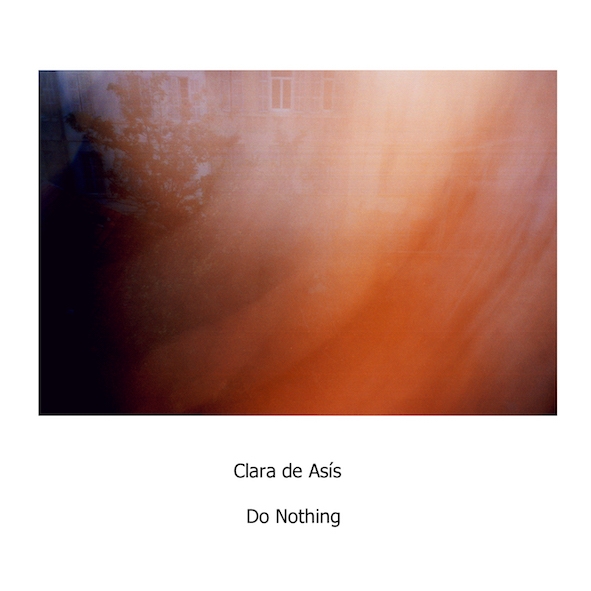
Do Nothing consists of a series of six pieces with the word nothing figuring in each title. Each piece is a concentrated realization of its titular idea; the degree of predetermined detail is hard to determine. The opening title piece offers the slow alternation of single guitar tones and struck percussion. For the composer, it “could refer to the moments where, between two actions, I stay quiet and let the sound live. It’s about what happens in between . . .” Say Nothing is a single guitar tone struck repeatedly and allowed to decay until eventually (around the five-minute mark) a small gong enters. What is remarkable in de Asís’ work is the sense of wonder abiding in these minimal gestures, a restraint (at the heart of Cage aesthetics) in which the music refines performer and listener in contrast to the usual sequence of production. By the time de Asís reaches Be Nothing, which begins in the resonant trace of an absence, there is simply nothing to say.
Stuart Broomer has written extensively on music, mostly improvised, for both general and specialist publications, and his liner essays have appeared on CDs by musicians from some 20 countries. The author of Time and Anthony Braxton (Mercury, 2009), he is currently writing a fantasia on the life of Memphis disc jockey Dewey Phillips. He has been intermittently active as an improvising musician since 1965; his composition Found Theme for the Age of Reason appeared in Musicworks 112. He lives in Toronto.