
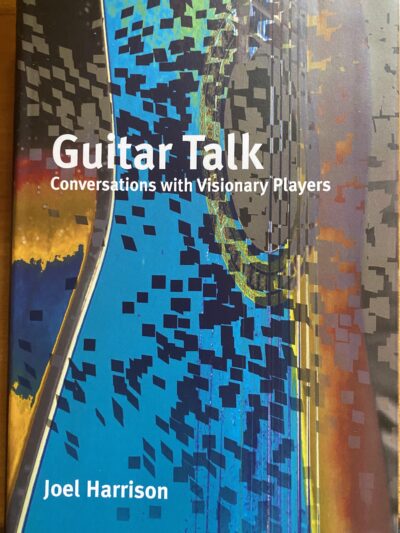
The modern electric guitar, resplendent in its bright automobile finish, emerged out of the defence-industry boom in post-World War II California. It came almost immediately to signify not just the futuristic, but futurity—the very concept of the future—itself. (It also came to signify some other things: priapic masculinity, rebellious potency, and the United States of America; the last of which was infamously at play in the despair of British left-wing folkies at the sight of Bob Dylan brandishing a Fender Stratocaster for the first time.) It is not surprising that many of the most compelling musical adventurers of the last decades have chosen the electric guitar as their tool of choice. Joel Harrison’s new book Guitar Talk puts the futurity of the electric guitar front and centre, assembling a series of fascinating interviews with guitarists committed to exploring new and uncharted trajectories for the instrument—“creative, renegade guitar playing in jazz, avantgarde, and new-music contexts,” as the author puts it. Harrison is well-qualified for the task: a fine guitarist himself, he has served as curator of the Alternative Guitar Summit in New York for over a decade.
Guitar Talk draws helpful connections between the overlapping lineages of the electric guitar as an experimental toolkit. One lineage spirals out from Boston’s Berklee College of Music, the epicentre of practical jazz education in the 1970s and 1980s. While not a Berklee alumnus, Ralph Towner (Harrison’s first interviewee) might be seen as a guiding light for many of the jazz guitarists of the era. As the electric guitar headed in noisier and noisier directions under the influence of psychedelic rock, heavy metal, and punk music, Towner and those influenced by him emphasized gentle textures, clean tones, and pastoral themes. This turn to meditative explorations of the guitar’s harmonic potential, aided by the complementary aesthetic of the ECM record label, coloured the culture of young jazz guitarists at Berklee in the 1970s, such as Pat Metheny, Bill Frisell, and Mike Stern, who all sit down for Guitar Talk interviews.
Harrison traces another lineage back to British experimental music and the pioneering avant-garde rock of Henry Cow. For most who play experimental guitar, Derek Bailey and Keith Rowe loom large as innovators and sources of inspiration. Rowe, however, is only mentioned once in the text. Bailey’s name appears more frequently, but I was left wishing for a more detailed discussion of his concrete contributions. Instead, Henry Cow founder Fred Frith serves as Guitar Talk’s main conduit to the British tradition. Frith questions the meaning of noise as it has been used in relation to American underground music and provides a fascinating review of his years teaching at Mills College, a crucial institution (now in danger of being permanently closed) at the heart of American experimental music culture.
The third key lineage is that of the electric guitar as a lead voice in the music of African American Freedom Dreams (borrowing a phrase from Robin D. G. Kelley). Key figures in a non-exhaustive list here would include Jimi Hendrix, Eddie Hazel, Sonny Sharrock, and Pete Cosey, through to Michael Gregory Jackson, Vernon Reid, and Brandon Ross. Interviews with these last three provide some of the most engaging moments of Guitar Talk. Jackson—recently the subject of a major rediscovery effort on the part of younger listeners—details a complex series of encounters with both the loft-jazz scene of the 1970s and the commercial music industry in the post-disco era. We learn of Jackson’s innovations regarding the adaptation of the electric guitar to the distinctive sound of the post-Coltrane saxophone (bending the neck, combining signal processors, manipulating the stereo signal), which may well shift the way guitarists discuss the origins of contemporary guitar technique.
A fourth lineage might be called the American maverick-outsider tradition: leading lights profiled in Guitar Talk are Henry Kaiser, Nels Cline, and Elliott Sharp. (Conspicuously absent here, however, are Eugene Chadbourne and Marc Ribot.) Harrison’s interview with Sharp reminds us of the convergence of factors that influenced the maverick tradition: cheap rent in downtown Manhattan in the late 1970s due to escalating fiscal and social crises; the rise of punk rock and its decentralized network of labels and venues; and technological evolutions on the gear side of things, which rendered most of the sounds of IRCAM available to the lay guitarist with a few hundred dollars to spare at the music store. Conversations with Kaiser and Cline emphasize the significance of the American West Coast as a centre of innovation during the 1970s and 1980s, with reverberations from the Bay Area psychedelic revolution of the late 1960s and, a decade later, from the Los Angeles punk scene that shaped and reshaped the character of musical experimentation.
Out of these four streams, a host of brilliant younger musicians now occupy the centre of the progressive guitar world, for example: Ben Monder, whose harmonic adventurousness builds on the innovations of the Berklee-bred guitarists of the 1970s; Mary Halvorson, who miraculously combines the extended techniques of Bailey and Frith with the jazz accents of mentors Anthony Braxton and Joe Morris (the latter another notable absence in the book, given his outsized influence on the next generation of improvisers); and Miles Okazaki, an imaginative plectrist with a refined rhythmic sensibility. These three, and a half dozen more emerging musicians, provide some of the most valuable commentary to be found in the pages of Guitar Talk.
Critics of Harrison’s Alternative Guitar Summit have pointed to its overwhelming whiteness and maleness—and I have been among them. Guitar Talk clearly and commendably strives towards a more balanced representation, though it does not approach gender parity. At times, Harrison’s efforts to address questions of identity politics within the Q-and-A format appear to frustrate the interview subjects, some of who correctly note that such questions are not typically asked of white male guitarists. It seems that the way forward is for a much more muscular effort to balance faculties and concert bills and to allow interviewees more power to direct the extent to which identity figures into conversations.
Notwithstanding such concerns, Guitar Talk is an excellent guide to the history and future of the guitar in jazz, free improvisation, and experimental music, and I hope for follow-up volumes in the future.
Kurt Newman is a guitarist and improvisor.