
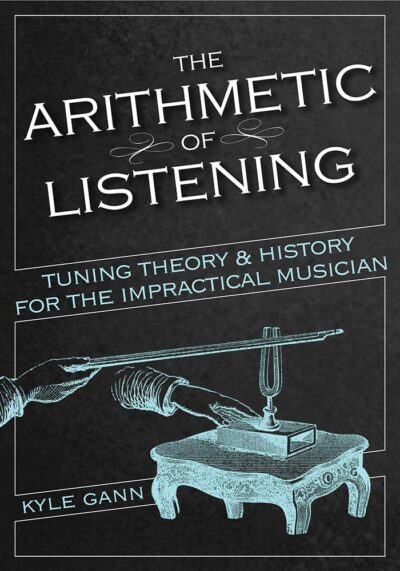
In addition to being a fascinating composer (e.g. the exuberant microtonal multi-Disklavier opus Hyperchromatica) and a professor of music theory and composition at Bard College, Kyle Gann remains one of the best-known contemporary-music critics, thanks to his writing for the Village Voice from 1986 to 2005.
As a writer, Gann has always had a gift for precision, insight, and levity in a realm that so easily lapses into esoteric insularity and haughty elitism. With The Arithmetic of Listening, he outdoes himself by bringing all these qualities to the field of tuning theory—an area that’s rife with jargon and wild numerical abstractions.
Gann is exceptionally knowledgeable about this topic, having made it a central aspect of his own creative practice. Some of his pieces employ complex pitch schema that push well beyond the now-standard twelve-note equal-temperament. Nonetheless, even with all his ability and wit as wordsmith, and not to mention practical experience as composer, it’s still a wonder that he has managed to craft such an accessible, engaging, and thorough manual.
That’s not to say the concepts it contains aren’t sometimes tricky to comprehend, but the feeling one gets while reading is that the author is in your corner. Gann maintains a twofold perspective, at once ensconced in the world of harmonic minutiae, but also utterly compassionate toward the non-specialist reader. He reveals the latter dimension in the book’s introduction, where he narrates his own cautious immersion into just intonation via the tutelage of Ben Johnston (to whom the book is dedicated). He finishes this anecdote with a clear statement of intent: “I needed to be able to feel all the intervals I was using, and it was admittedly not an easy transition. My hope is that this book will ease that process for others.”
The text is well organized and places equal emphasis on economy and clarity. His website also hosts audio appendices for each chapter. Each section addresses particular theoretical constructs, but also outlines these ideas in historical context, stretching all the way back to Ptolemy, touching on the common-practice era, and examining living composers such as himself, Johnston, and LaMonte Young. While the examples serve to situate intonational innovations within a chronology, they also illustrate the highly personal terms on which artists have come to understand these intervals and integrated them into their individual modes of expression.
Clearly, his thinking emerges from just intonation, which derives from the naturally occurring intervallic relationships of the harmonic series. Nothing drives this home like his savvy take-down of twelve-step equal temperament, yet he does devote nearly fifty pages of analysis to other artificial temperaments (including quartertones) toward the end of the book.
In addition to being informative, Arithmetic of Listening is downright digestible, if you’re curious about the subject matter, and this is arguably it’s most notable feature. Laced with amusing quips—such as “music teachers will teach you about the ‘circle of fifths’; try to keep in mind, and be polite when correcting them, that it is actually a spiral”—the text glides forward effortlessly. While the book is undoubtedly a vital resource for composers, researchers, and the like, it’s easy to imagine it carrying greater implications. Perhaps its charismatic prose is just the nudge microtonality needs to gain a foothold in mainstream pedagogical discourse.
Find out more about Kyle Gann here.
Nick Storring is a Toronto-based composer, musician, and writer, and a contributing editor to Musicworks. His music has been presented and performed by the Esprit Orchestra, Eve Egoyan, Quatuor Bozzini, Beijing’s Musicacoustica Festival, and Vancouver New Music. An avid collaborator, Storring has composed for films by Terrance Odette, Ingrid Veninger and, in collaboration with Dafydd Hughes, for the National Film Board’s award-winning Web documentary High Rise: Universe Within (2015), directed by Katerina Cizek. He’s also scored productions by Litmus Theatre and MT Space, worked with celebrated choreographers Yvonne Ng, Marie Josée Chartier, Brandy Leary, and Deepti Gupta, and created music for “ambient gaming environment” Tentacle, which was mounted at New York’s Museum of Modern Art in 2011. Storring’s writing has appeared in Exclaim!, The Wire, and AUX.tv. He also contributed liner notes to Alga Marghen’s reissue of the ’60s band Intersystems’ entire recorded output, as well as RVNG Intl.’s box of early psych trio Syrinx’s reissues and previously unreleased material Tumblers from the Vault.