
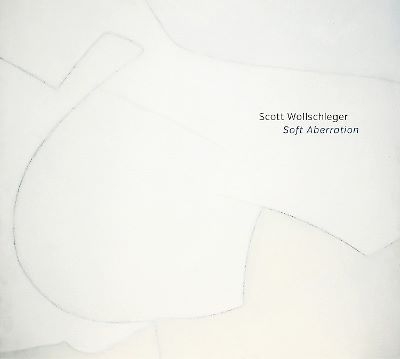
Brooklyn-based composer Scott Wollschleger has a sharp, stylish sense of how to deploy bold motives yet avoid bombast. His colouristic universe naturally and fluidly embraces both traditional and extended instrumental vocabularies. Often these attributes combine in a smeared, wayward lyricism with tenuous gestures that skew off along dusty paths, or saturated sonic fields that dazzle like aural snow blindness. It’s music that is generously mysterious—candid and readily decipherable, but somehow eluding grasp at the same time. Or, at least, that had been my experience of it thus far.
Depending on one’s entry-point into Wollschleger’s sizable catalogue, the contents of Soft Aberration, his debut album, might prove slightly surprising in its apparent outward orientation. The deliberate rhythms and piano-mashing interjections of the album opener “Brontal Symmetry” seem uncharacteristically cartoonish. It is brimming with brilliant composite sonorities, but it might jar listeners accustomed to his works, both active and more sparse, that unfold along the aforementioned lines.
The reflective, Feldmanesque “Soft Aberration no. 2” feels more personal in scope—full of patiently decaying piano and viola figures that disintegrate into chalky whispers. The material contained within the cello solo “America” is seductively recursive and obsessive in its logic. Yet the anxious virtuosity of its delivery shoehorns the disorienting ambiguity into the same tense emotional sphere as early modernism. “Bring Something Incomprehensible Into This World,” a trumpet and voice duet of spartan strangeness, is one of the album’s strongest works—when digested whole; but its parts are divided up and sprinkled throughout the disc. Rather than bringing cohesion to the disc—the supposed rationale behind treating the piece’s constituent sections as interludes—the tactic breaks the disc’s stubborn spell.
The works compiled on Soft Aberration are by no means weak, or even unrepresentative per se, yet the selections and sequencing are certainly slanted toward Wollschleger’s most immediate, extrovert pieces. It feels akin to having an extended chat with him at a party, rather than coming over to visit him in his home. Consider this record an invitation to befriend and get to know Wollschleger: he’s among the most interesting American composers of his generation.
Nick Storring is a Toronto-based composer, musician, and writer, and a contributing editor to Musicworks. His music has been presented and performed by the Esprit Orchestra, Eve Egoyan, Quatuor Bozzini, Beijing’s Musicacoustica Festival, and Vancouver New Music. An avid collaborator, Storring has composed for films by Terrance Odette, Ingrid Veninger and, in collaboration with Dafydd Hughes, for the National Film Board’s award-winning Web documentary High Rise: Universe Within (2015), directed by Katerina Cizek. He’s also scored productions by Litmus Theatre and MT Space, worked with celebrated choreographers Yvonne Ng, Marie Josée Chartier, Brandy Leary, and Deepti Gupta, and created music for “ambient gaming environment” Tentacle, which was mounted at New York’s Museum of Modern Art in 2011. Storring’s writing has appeared in Exclaim!, The Wire, and AUX.tv. He also contributed liner notes to Alga Marghen’s reissue of the ’60s band Intersystems’ entire recorded output, as well as RVNG Intl.’s box of early psych trio Syrinx’s reissues and previously unreleased material Tumblers from the Vault.